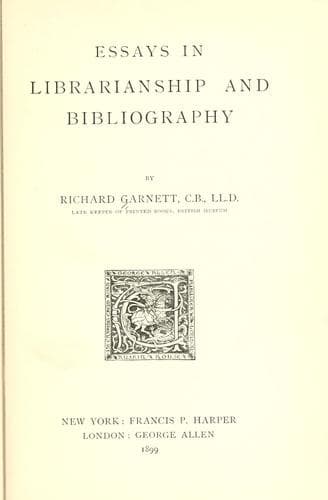
Essays in Librarianship and BibliographyGarnett, Richard
Science
Essays in Librarianship and Bibliography
Garnett, Richard
Bibliography -- Methodology; British Museum; Library science
part, his diligence and acumen will appear not more worthy of praise
than his disinterested zeal. It might be well for the directors of
English free libraries to consider whether something similar could not
be produced by co-operation. The list of scientific books recommended to
students at the Radcliffe Library, Oxford, is most useful and creditable
as far as it goes. Generally speaking, the condition of free public
libraries in England may be considered satisfactory; among the directors
are many men not merely of administrative quality, but of high
bibliographical attainments. The principal obstacles to their usefulness
may be briefly characterised as the popular and municipal parsimony. Of
the former we have spoken; the latter requires to be dealt with
tenderly, and is not equally applicable to every locality; it is
nevertheless the fact that in many towns the allotted grant is
insufficient to maintain the library and librarian together. Nowhere is
the cause of free libraries so backward as in London, although the
Guildhall library is an honour to the city. The other metropolitan
districts, notwithstanding, continue deaf to Mr. Nicholson's earnest
expostulations; and although the number of readers at the British Museum
is as large as that institution can well deal with, it seems small in
comparison with the vastness of the metropolis and the occasions for
reference to books which continually arise in the daily life of even the
least lettered members of the community. The suggested opening at night
by the aid of the electric light would almost certainly attract a new
and valuable class of students, at present virtually excluded. It would
be premature to say much about the recent experiments with the electric
lamp; but we believe it may be stated that they have been highly
encouraging as far as they have gone, and that the question is safe in
the hands of Mr. Bond, to whom the public are already indebted for so
many signal improvements.[64:1] Should the experiments result in perfect
success, it is to be hoped that their object will not be frustrated by
the propensity of all governments to save where they ought to spend,
that they may spend where they ought to save. To allow the infinitesimal
risk of accident to the institution to obstruct the full development of
its usefulness would indeed be _propter vitam vivendi perdere causas_.
Public-domain text, read in full here on John Shaqi.
Reviews
Reviews
No reviews yet
Be the first to share your thoughts on this work.
Join the Discussion
Join the discussion
Sign in to leave a comment or review.
Sign InorCreate an account