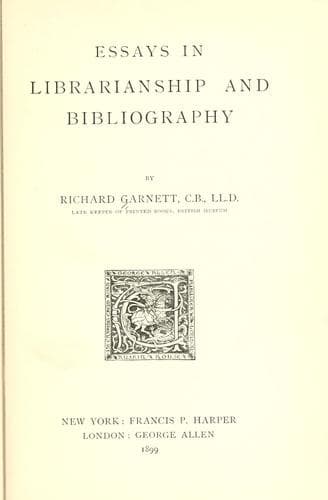
Essays in Librarianship and BibliographyGarnett, Richard
Science
Essays in Librarianship and Bibliography
Garnett, Richard
Bibliography -- Methodology; British Museum; Library science
While discussion respecting the printing of the Museum Catalogue was
proceeding, the character of the catalogue itself was undergoing
modification. Great additions were daily being made to the number of
books. The new entries thus rendered requisite were at first made in the
old manuscript catalogue of additions interleaved with the original
printed catalogue of Sir Henry Ellis and Mr. Baber. Two alphabetical
series of titles, one printed and the other manuscript, were thus
comprised within the same volumes. The amalgamation of these two sets of
titles, and the consequent absorption of the catalogue commenced in 1839
into a more extensive general catalogue, was effected by the ingenious
and admirable suggestion, made independently in 1849 by Mr. Wilson
Croker and Mr. Roy, of the Library, that the entries, instead of being
written upon the leaf itself, should be written upon movable slips
pasted upon it, so that insertions might be made without any disturbance
of alphabetical order. The suggestion was promptly adopted, transcribers
were engaged to copy the great mass of accumulated titles, and, all
thoughts of printing the catalogue commenced in 1839 being laid aside
for the present, the titles prepared for it were also transcribed and
incorporated with those written for the books newly acquired. In 1851
this new catalogue, transcribed fourfold by the "carbonic" process, and
with copious space provided for insertions and interleavings, was placed
in the Reading Room in 150 volumes, or about as many as are now occupied
by letter B alone. The catalogue of 1839 and the supplementary catalogue
were thus put into a fair way to become one, and it became obvious that
printing must be deferred until the amalgamation was complete. It was
still, however, a fair question whether the catalogue might not be kept
up in print; whether it was better to transcribe titles fourfold as we
did then, or to multiply them indefinitely by print as we do now. I
cannot find that the practicability of keeping up a continually
augmenting catalogue in print was seriously considered, until, in
October 1861, it was proved by the introduction of print into the
University Library of Cambridge. Some years afterwards the system was
strongly pressed upon the attention of the Museum by the Treasury,
which had remarked the gradual and inevitable increase of expenditure in
binding, breaking up, interleaving and relaying the volumes of the
manuscript catalogue, increased by this time from 150 to 1500. I well
remember the pains which Mr. Rye, then keeper of the printed books, took
in investigating the subject, and I believe I may say that had it
depended upon him, the transition to print would have been effected
immediately. Other views, however, prevailed for the time; and when, in
October 1875, the subject was again brought forward by the Treasury, it
fell to my lot to treat it from a new point of view, suggested by my
Public-domain text, read in full here on John Shaqi.
Reviews
Reviews
No reviews yet
Be the first to share your thoughts on this work.
Join the Discussion
Join the discussion
Sign in to leave a comment or review.
Sign InorCreate an account