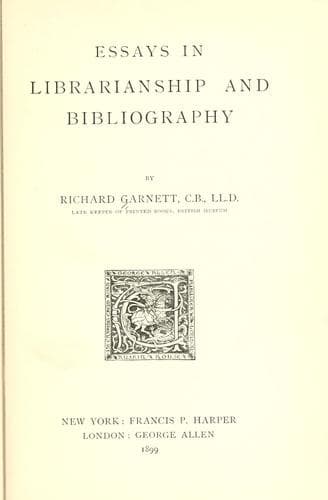
Essays in Librarianship and BibliographyGarnett, Richard
Science
Essays in Librarianship and Bibliography
Garnett, Richard
Bibliography -- Methodology; British Museum; Library science
I shall now proceed to take up some of the more interesting themes
broached at the first meeting of the Association, time not allowing me
to proceed further, and to remark upon the progress which may appear to
have been made in the interval towards accomplishing the objects then
indicated. I shall then venture some brief remarks on the library
movement at the present day, as concerns public feeling and public
sympathy in their effect on the status of librarianship as a profession.
My observations must of course be very desultory and imperfect, for an
adequate treatment of these subjects would absorb the entire time of the
present meeting. I have also always felt that the President's address,
though certainly an indispensable portion of our proceedings, is in one
aspect ornamental, and that the real business of a meeting, apart from
its legislative and administrative departments, is the reading of papers
and the discussion to which these give rise. I hope that these
discussions will be, like the Thames, "without o'erflowing, full."
Overflow we must not. It will be a great satisfaction to me if, when the
meeting is over, it should be found that everything written for it has
been heard by it, and that nothing has been "taken as read."
The most important subject introduced at the Conference of 1877 was that
of free libraries in small towns, but any remarks which I may offer on
this will come more appropriately into a review of the progress which
libraries are now making. Next in importance, perhaps, certainly in
general interest, were the discussions on cataloguing. In this
department I may congratulate the Association on material progress, to
which its own labours have, in great measure, contributed. There is much
more unanimity than there used to be respecting the principles on which
catalogues should be made. Admirable catalogues have been issued, and
continue to be kept up by the principal libraries throughout the
country, and if now and then some very small and benighted library
issues a catalogue whose _naïvetés_ excite derision, such cases are
very exceptional. Rules have been promulgated both here and in the
United States which have met with general assent, and I do not
anticipate that any material departure from them will be made. I only
wish to say, as every librarian is naturally supposed to regard his own
catalogue as a model, that I do not regard the British Museum Catalogue
in this light so far as concerns libraries of average size and type. The
requirements of large and small libraries are very different, and that
may be quite right in one which would be quite wrong in another. I can,
perhaps, scarcely express this difference more accurately than by
remarking that while the catalogue of a small, and more especially of a
popular, library, should be a finding catalogue, that of a large library
representing all departments of literature must be to a great extent a
literary catalogue. It is not meant merely to enable the reader to
Public-domain text, read in full here on John Shaqi.
Reviews
Reviews
No reviews yet
Be the first to share your thoughts on this work.
Join the Discussion
Join the discussion
Sign in to leave a comment or review.
Sign InorCreate an account