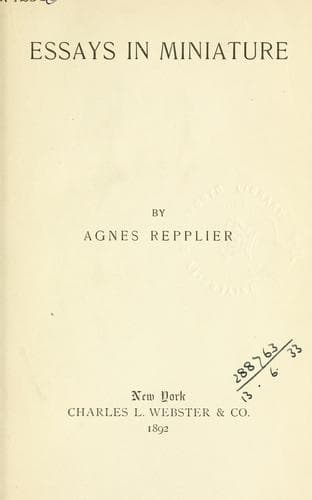
American essays -- 19th century; Literature -- History and criticism
That innocent nondescript, the average reader, is suffering very sorely
at the present day from what might be justly called the oppression or
tyranny of notes. I hear, indeed, from time to time, bitter complaints
of editorial inaccuracy, of the unscholarly treatment of quite forgotten
masterpieces by the industrious gentlemen who seek to reintroduce them
to the public; but such inaccuracy can wound only the limited number who
know more than the editor, and who in their secret souls are not sorry to
prove him wrong. The average reader, even though he hold himself to be
of moderate intelligence, is happily ignorant of such fine shadings, and
only asks that he may enjoy his books in a moderately intelligent manner;
that he may be helped over hedges and ditches, and allowed to ramble
unmolested where the ground seems tolerably smooth. This is precisely
the privilege, however, which a too liberal editor is disinclined to
allow. He will build you a bridge over a raindrop, put ladders up a
pebble, and encompass you on every side with ingenious alpenstocks and
climbing-irons; yet when, perchance, you stumble and hold out a hand for
help, behold, he is never there to grasp it. He merely refers you, with
some coldness, to a remote authority who will give you the assistance
you require when you have reached the end of your journey. Mr. Ritchie,
for example, who has recently edited a volume of Mrs. Carlyle’s early
letters, expects you patiently to search for the information you want in
Mr. Froude’s pages, which is always a disheartening thing to be asked to
do. Yet when Jeanie Welsh, writing cheerfully of an inconstant lover,
says, “_Mais n’importe!_ It is only one more Spanish castle demolished;
another may start up like a mushroom in its place;” an explanatory note
carefully reveals to you that “Spanish castle” really means “château en
Espagne”—a circumstance which even Macaulay’s schoolboy would probably
have deciphered for himself.
If it be hard on the average reader to be referred chillingly to modern
writers who are at least within approachable distance, it is harder still
to be requested to look up classical authorities. If it be hard to be
told occasionally by that prince of good editors, Mr. Alfred Ainger, to
please turn elsewhere for the little bits of information which we think
he might give us about Charles Lamb, it is harder still to have Mr.
Wright refuse to translate for us Edward Fitzgerald’s infrequent lapses
into Greek. What is the use of saying in a note “v. 9” when Fitzgerald
quotes Herodotus? If I can read the quotation for myself, I have no
need to hunt up v. 9; and if I can’t, v. 9 is of no use to me when
found. Even “Hor. Od. I. 4, 14, 15,” is not altogether satisfactory to
the indifferent scholar, for whom Fitzgerald himself had such generous
sympathy, and for whom his translations were avowedly undertaken.
Public-domain text, read in full here on John Shaqi.
Reviews
Reviews
No reviews yet
Be the first to share your thoughts on this work.
Join the Discussion
Join the discussion
Sign in to leave a comment or review.
Sign InorCreate an account