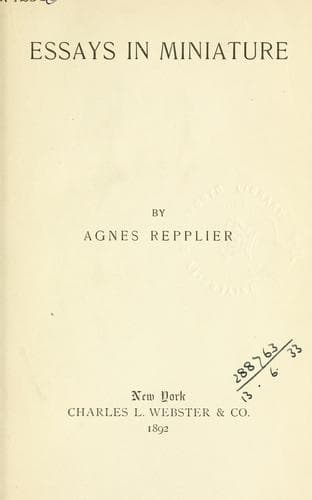
American essays -- 19th century; Literature -- History and criticism
A great many years ago, when I was a little girl, I used to know a dear,
placid, sunny-tempered old lady who was stone-deaf and an insatiable
novel-reader. She always came to our house bearing a black bag which held
her jointed ear-trumpet, and she always left it with a borrowed novel
under her arm. As she had reached that comfortable period of life when
a book is as easily forgotten as read, our slender library supplied all
her demands, on the same principle of timely reappearance which makes an
imposing stage army out of two dozen elusive supernumeraries. She had a
theory of selection all her own, and to which she implicitly trusted.
She glanced over a story very rapidly, and if it had too many solid,
page-long paragraphs—reflections, descriptions, etc.—she put it sadly
but steadfastly aside. If, on the contrary, it was well broken up into
conversations, which always impart an air of sprightliness to a book, she
said she was sure she would like it, and carried it off in triumph.
Those were not days, be it remembered, when people wrote fiction for the
sake of introducing discussions. There still lingered in the novelist’s
mind the time-worn heresy that he had a story to tell, and that his
people must act as well as talk. The plot—delightful and obsolete
word!—was then in good repute, and conversation was mainly useful in
helping on the tale, in providing copious love scenes, and, with really
good novelists, in illustrating and developing character. Thomas Love
Peacock’s inimitable dialogues had indeed been long given to the world;
but quiet people of restricted cultivation knew nothing of them, and
would have found it difficult to realize their loss. I can hardly fancy
our dear old friend reading and enjoying the delicious war of words in
_Crotchet Castle_, and I should be grieved to think of her suddenly
confronted with those scraps of sententious wisdom, in which its author
took a truly impish and reprehensible delight. Such a sentiment as “Men
have been found very easily permutable into ites and onians, avians and
arians,” might have sorely puzzled her benign and tranquil soul.
Public-domain text, read in full here on John Shaqi.
Reviews
Reviews
No reviews yet
Be the first to share your thoughts on this work.
Join the Discussion
Join the discussion
Sign in to leave a comment or review.
Sign InorCreate an account