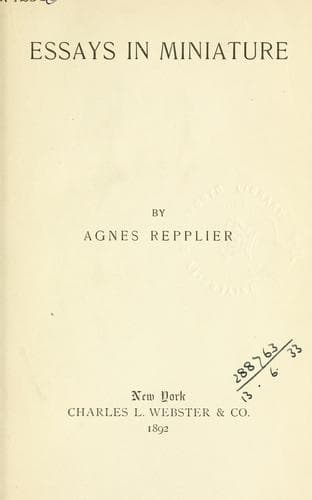
American essays -- 19th century; Literature -- History and criticism
Yet no one can accuse Peacock of writing his novels in order to express
his own personal convictions. The fact is that, after reading them, we
are often very much in the dark as to what his convictions were. We know
he loved old things better than new ones, and wine better than water; and
that is about as far as we can follow him with security. “The intimate
friends of Mr. Peacock may have understood his political sentiments,”
says Lord Houghton disconsolately, “but it is extremely difficult to
discover them from his work.” His people simply talk in character,
sometimes tiresomely, sometimes with unapproachable keenness and humor,
and the scope of his stories hardly permits any near approach to the
fine gradations, the endless variety, of life. Mr. Chainmail never opens
his lips save in praise of feudalism. Mr. Mac Quedy discusses political
economy only. Even the witty Dr. Folliott, “a fellow of infinite jest,”
seldom gets beyond the dual delights of Greek and dining. It is all
vastly piquant and entertaining, but it is leagues away from the casual
conversation, the little leisurely, veracious gossip in which Jane Austen
reveals to us with merciless distinctness the secret springs that move
a human heart. She has scant need to describe her characters, and she
seldom takes that trouble. They betray themselves at every word, and
stand convicted on their own evidence. We are not warned in advance
against Isabella Thorpe. We meet her precisely as Catherine meets her
in the Pump-room at Bath, where the young lady speedily opens her lips,
and acquaints us in the most vivacious manner with her own callous
folly and selfishness. Every syllable uttered by Mrs. Norris is a new
and luminous revelation; we know her just that much better than we did
before she spoke. Even _Sense and Sensibility_, by no means the best of
Miss Austen’s novels, starts with that admirable discussion between Mr.
John Dashwood and his wife on the subject of his mother’s and sisters’
maintenance. It is a short chapter, the second in the book, and at its
close we are masters of the whole situation. We have sounded the feeble
egotism of Mr. Dashwood, and the adroit meanness of his spouse. We know
precisely what degree of assistance Elinor and Marianne are likely to
receive from them. We foresee the relation these characters will bear to
each other during the progress of the story, and we have been shown with
delicious humor how easy and pleasant is the task of self-deception. That
a girl of nineteen should have been capable of such keenly artistic work
is simply one of the miracles of literature; and the more we think about
it, the more miraculous it grows. The best we can do is to bow our heads,
and pay unqualified homage at its shrine.
Public-domain text, read in full here on John Shaqi.
Reviews
Reviews
No reviews yet
Be the first to share your thoughts on this work.
Join the Discussion
Join the discussion
Sign in to leave a comment or review.
Sign InorCreate an account