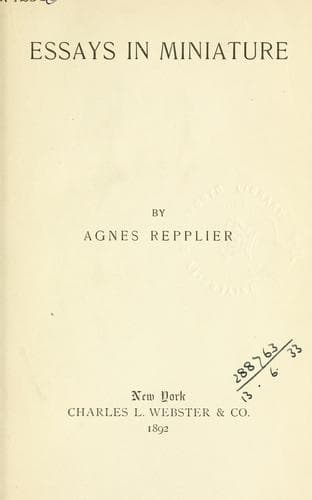
American essays -- 19th century; Literature -- History and criticism
Some portion of Jane Austen’s ability for portraying character in
conversation is discernible in at least one of her too numerous
successors in the craft. The authoress of _Mademoiselle Ixe_ and
of _Cecilia de Noël_ has already proven to the world how deft and
skilful is her manipulation of that difficult medium, drawing-room
gossip. It would be unjust and absurd to compare her stories, slight
and unsubstantial as pencil sketches, with the finished masterpieces
of English fiction; but there are touches in these modern tales which
convince even a casual reader of splendid possibilities ahead. The
setting of _Mademoiselle Ixe_ is so fine, the lightly drawn English
people who surround the mysterious governess and her still more
mysterious victim are so real, that we cease to ask ourselves obtrusive
questions concerning the purpose and utility of the crime. Better still
are some of the scenes in _Cecilia de Noël_, where Lady Atherley’s serene
and imperturbable good sense tempers the atmosphere, and gives exactly
the proper effect to her husband’s rather long-winded eloquence, to Mrs.
Mostyn’s amiable and cruel evangelism, and to Mrs. Molyneux’s amusing
eccentricities. All these characters have individuality of their own,
and all reveal themselves through the intricacies of conversation, while
occasionally there is a felicitous touch worthy of Jane Austen’s hand;
as when Lady Atherley listens tranquilly to Mrs. Mostyn’s tirade against
the ritualistic curate, and evolves from it the one judicious conclusion
that he is evidently an Austyn of Temple Leigh, and that it would be
desirable to ask him to dinner.
The real drawback to Lanoe Falconer’s art is, not the brevity of
her work, but the fact that her people cannot develop on purely
natural lines, because they are hampered by the terrible necessity of
illustrating a moral; and even in their most unguarded moments the task
assigned them is never wholly laid aside. It is seldom that a good tract
is a good story too, and all the novelist’s skill is powerless to impart
a vivid semblance of truth to characters who have to “talk up” to a given
subject, and teach a given lesson. The inartistic treatment of material
results, curiously enough, in weakening our sense of reality; yet if the
authoress of _Cecilia de Noël_ would consent, for a few short years,
to abandon social and spiritual problems, to concern herself as little
with Nihilism as with eternal punishment, but to be content, as Jane
Austen was content, with telling a story, perhaps that story might be
no unworthy successor of those matchless tales which are our refuge and
solace in these dark days of ethical and unorthodox fiction.
Public-domain text, read in full here on John Shaqi.
Reviews
Reviews
No reviews yet
Be the first to share your thoughts on this work.
Join the Discussion
Join the discussion
Sign in to leave a comment or review.
Sign InorCreate an account