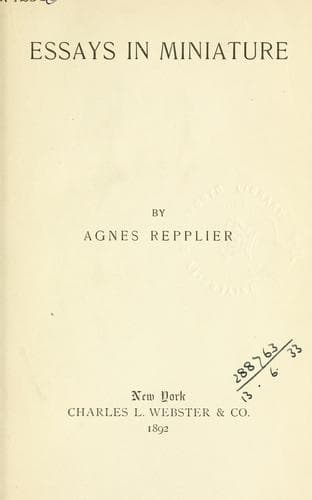
American essays -- 19th century; Literature -- History and criticism
There is a story told of the Russian poet, Pushkin, which I like to
think true, because it is so pretty. When he was carried home fatally
wounded from the duel which cost him his life, his young wife, who had
been the innocent cause of the tragedy, asked him whether there were no
relatives or friends whom he wished to see summoned to his bedside. The
dying man lifted his heavy eyes to the shelf where stood his favorite
books, and murmured faintly in reply, “Farewell, my friends.” When we
remember that Pushkin lived before Russian literature had become a great
and dispiriting power, when we realize that he had never been ordered
by critics to read Turguéneff, never commanded severely to worship
Tolstoi or be an outcast in the land, never even reveled in the dreadful
gloom of Dostoïevsky, it seems incredible to the well-instructed that
he should have loved his books so much. It is absolutely afflicting
to think that many of these same volumes were foreign, were romantic,
perhaps even cheerful in their character; that they were not his mentors,
his disciplinarians, his guides to a higher and sadder life, but only
his “friends.” Why, Hazlitt himself could have used no simpler term of
endearment. Charles Lamb might have uttered the very words when he closed
his patient eyes in the dull little cottage at Edmonton. Sir Walter
Scott might have murmured them on that still September morn when the
clear rippling of the Tweed hushed his tired heart to rest. I think that
Shelley bade some swift, unconscious farewell to all the dear delights of
reading, when he thrust into his pocket the little volume of Keats, with
its cover bent hastily backward, and rose, still dreamy with fairy-land,
to face a sudden death. I think that Montaigne bade farewell to the
fourscore “every-day books” that were his chosen companions, before
turning serenely away from the temperate pleasures of life.
For all these men loved literature, not contentiously, nor austerely,
but simply as their friend. All read with that devout sincerity which
precludes petulance, or display, or lettered asceticism, the most dismal
self-torment in the world. In that delicious dialogue of Landor’s between
Montaigne and Scaliger, the scholar intimates to the philosopher that
his library is somewhat scantily furnished, and that he and his father
between them have written nearly as many volumes as Montaigne possesses
on his shelves. “Ah!” responds the sage with gentle malice, “to write
them is quite another thing; but one reads books without a spur, or even
a pat from our Lady Vanity.”
Public-domain text, read in full here on John Shaqi.
Reviews
Reviews
No reviews yet
Be the first to share your thoughts on this work.
Join the Discussion
Join the discussion
Sign in to leave a comment or review.
Sign InorCreate an account