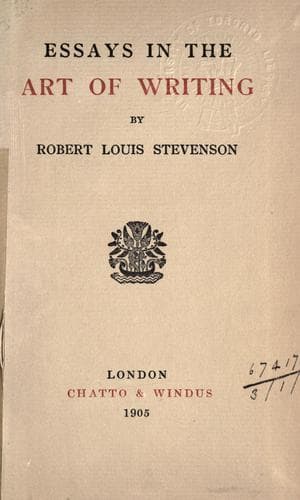
Essays in the Art of WritingStevenson, Robert Louis
History
Essays in the Art of Writing
Stevenson, Robert Louis
Authorship; Literature -- History and criticism; Stevenson, Robert Louis, 1850-1894 -- Authorship
making verse at all, it can never occur to him to extract those effects
of counterpoint and opposition which I have referred to as the final
grace and justification of verse, and, I may add, of blank verse in
particular.
4. _Contents of the Phrase_.—Here is a great deal of talk about
rhythm—and naturally; for in our canorous language rhythm is always at
the door. But it must not be forgotten that in some languages this
element is almost, if not quite, extinct, and that in our own it is
probably decaying. The even speech of many educated Americans sounds the
note of danger. I should see it go with something as bitter as despair,
but I should not be desperate. As in verse no element, not even rhythm,
is necessary, so, in prose also, other sorts of beauty will arise and
take the place and play the part of those that we outlive. The beauty of
the expected beat in verse, the beauty in prose of its larger and more
lawless melody, patent as they are to English hearing, are already silent
in the ears of our next neighbours; for in France the oratorical accent
and the pattern of the web have almost or altogether succeeded to their
places; and the French prose writer would be astounded at the labours of
his brother across the Channel, and how a good quarter of his toil, above
all _invita Minerva_, is to avoid writing verse. So wonderfully far
apart have races wandered in spirit, and so hard it is to understand the
literature next door!
Yet French prose is distinctly better than English; and French verse,
above all while Hugo lives, it will not do to place upon one side. What
is more to our purpose, a phrase or a verse in French is easily
distinguishable as comely or uncomely. There is then another element of
comeliness hitherto overlooked in this analysis: the contents of the
phrase. Each phrase in literature is built of sounds, as each phrase in
music consists of notes. One sound suggests, echoes, demands, and
harmonises with another; and the art of rightly using these concordances
is the final art in literature. It used to be a piece of good advice to
all young writers to avoid alliteration; and the advice was sound, in so
far as it prevented daubing. None the less for that, was it abominable
nonsense, and the mere raving of those blindest of the blind who will not
see. The beauty of the contents of a phrase, or of a sentence, depends
implicitly upon alliteration and upon assonance. The vowel demands to be
repeated; the consonant demands to be repeated; and both cry aloud to be
perpetually varied. You may follow the adventures of a letter through
any passage that has particularly pleased you; find it, perhaps, denied a
while, to tantalise the ear; find it fired again at you in a whole
broadside; or find it pass into congenerous sounds, one liquid or labial
melting away into another. And you will find another and much stranger
circumstance. Literature is written by and for two senses: a sort of
Public-domain text, read in full here on John Shaqi.
Reviews
Reviews
No reviews yet
Be the first to share your thoughts on this work.
Join the Discussion
Join the discussion
Sign in to leave a comment or review.
Sign InorCreate an account