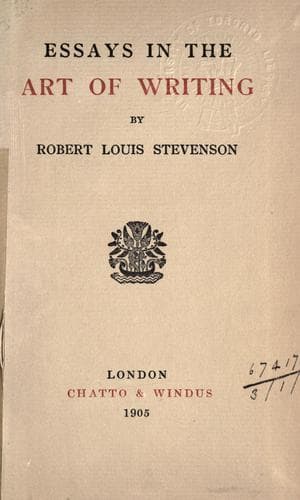
Essays in the Art of WritingStevenson, Robert Louis
History
Essays in the Art of Writing
Stevenson, Robert Louis
Authorship; Literature -- History and criticism; Stevenson, Robert Louis, 1850-1894 -- Authorship
This is to speak of literature at its highest; and with the four great
elders who are still spared to our respect and admiration, with Carlyle,
Ruskin, Browning, and Tennyson before us, it would be cowardly to
consider it at first in any lesser aspect. But while we cannot follow
these athletes, while we may none of us, perhaps, be very vigorous, very
original, or very wise, I still contend that, in the humblest sort of
literary work, we have it in our power either to do great harm or great
good. We may seek merely to please; we may seek, having no higher gift,
merely to gratify the idle nine days’ curiosity of our contemporaries; or
we may essay, however feebly, to instruct. In each of these we shall
have to deal with that remarkable art of words which, because it is the
dialect of life, comes home so easily and powerfully to the minds of men;
and since that is so, we contribute, in each of these branches, to build
up the sum of sentiments and appreciations which goes by the name of
Public Opinion or Public Feeling. The total of a nation’s reading, in
these days of daily papers, greatly modifies the total of the nation’s
speech; and the speech and reading, taken together, form the efficient
educational medium of youth. A good man or woman may keep a youth some
little while in clearer air; but the contemporary atmosphere is
all-powerful in the end on the average of mediocre characters. The
copious Corinthian baseness of the American reporter or the Parisian
_chroniquear_, both so lightly readable, must exercise an incalculable
influence for ill; they touch upon all subjects, and on all with the same
ungenerous hand; they begin the consideration of all, in young and
unprepared minds, in an unworthy spirit; on all, they supply some
pungency for dull people to quote. The mere body of this ugly matter
overwhelms the rare utterances of good men; the sneering, the selfish,
and the cowardly are scattered in broad sheets on every table, while the
antidote, in small volumes, lies unread upon the shelf. I have spoken of
the American and the French, not because they are so much baser, but so
much more readable, than the English; their evil is done more
effectively, in America for the masses, in French for the few that care
to read; but with us as with them, the duties of literature are daily
neglected, truth daily perverted and suppressed, and grave subjects daily
degraded in the treatment. The journalist is not reckoned an important
officer; yet judge of the good he might do, the harm he does; judge of it
by one instance only: that when we find two journals on the reverse sides
of politics each, on the same day, openly garbling a piece of news for
the interest of its own party, we smile at the discovery (no discovery
now!) as over a good joke and pardonable stratagem. Lying so open is
scarce lying, it is true; but one of the things that we profess to teach
our young is a respect for truth; and I cannot think this piece of
Public-domain text, read in full here on John Shaqi.
Reviews
Reviews
No reviews yet
Be the first to share your thoughts on this work.
Join the Discussion
Join the discussion
Sign in to leave a comment or review.
Sign InorCreate an account