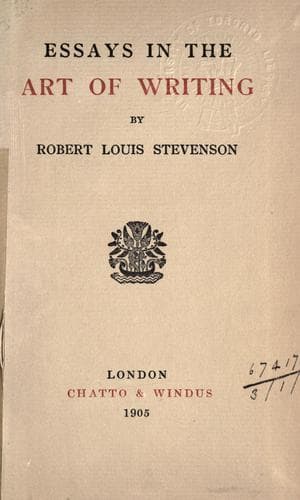
Essays in the Art of WritingStevenson, Robert Louis
History
Essays in the Art of Writing
Stevenson, Robert Louis
Authorship; Literature -- History and criticism; Stevenson, Robert Louis, 1850-1894 -- Authorship
education will be crowned with any great success, so long as some of us
practise and the rest openly approve of public falsehood.
There are two duties incumbent upon any man who enters on the business of
writing: truth to the fact and a good spirit in the treatment. In every
department of literature, though so low as hardly to deserve the name,
truth to the fact is of importance to the education and comfort of
mankind, and so hard to preserve, that the faithful trying to do so will
lend some dignity to the man who tries it. Our judgments are based upon
two things: first, upon the original preferences of our soul; but,
second, upon the mass of testimony to the nature of God, man, and the
universe which reaches us, in divers manners, from without. For the most
part these divers manners are reducible to one, all that we learn of past
times and much that we learn of our own reaching us through the medium of
books or papers, and even he who cannot read learning from the same
source at second-hand and by the report of him who can. Thus the sum of
the contemporary knowledge or ignorance of good and evil is, in large
measure, the handiwork of those who write. Those who write have to see
that each man’s knowledge is, as near as they can make it, answerable to
the facts of life; that he shall not suppose himself an angel or a
monster; nor take this world for a hell; nor be suffered to imagine that
all rights are concentred in his own caste or country, or all veracities
in his own parochial creed. Each man should learn what is within him,
that he may strive to mend; he must be taught what is without him, that
he may be kind to others. It can never be wrong to tell him the truth;
for, in his disputable state, weaving as he goes his theory of life,
steering himself, cheering or reproving others, all facts are of the
first importance to his conduct; and even if a fact shall discourage or
corrupt him, it is still best that he should know it; for it is in this
world as it is, and not in a world made easy by educational suppressions,
that he must win his way to shame or glory. In one word, it must always
be foul to tell what is false; and it can never be safe to suppress what
is true. The very fact that you omit may be the fact which somebody was
wanting, for one man’s meat is another man’s poison, and I have known a
person who was cheered by the perusal of _Candide_. Every fact is a part
of that great puzzle we must set together; and none that comes directly
in a writer’s path but has some nice relations, unperceivable by him, to
the totality and bearing of the subject under hand. Yet there are
certain classes of fact eternally more necessary than others, and it is
with these that literature must first bestir itself. They are not hard
to distinguish, nature once more easily leading us; for the necessary,
because the efficacious, facts are those which are most interesting to
the natural mind of man. Those which are coloured, picturesque, human,
Public-domain text, read in full here on John Shaqi.
Reviews
Reviews
No reviews yet
Be the first to share your thoughts on this work.
Join the Discussion
Join the discussion
Sign in to leave a comment or review.
Sign InorCreate an account