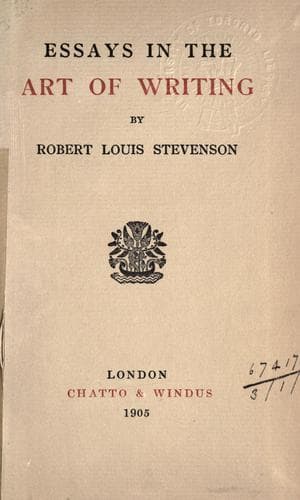
Essays in the Art of WritingStevenson, Robert Louis
History
Essays in the Art of Writing
Stevenson, Robert Louis
Authorship; Literature -- History and criticism; Stevenson, Robert Louis, 1850-1894 -- Authorship
Man is imperfect; yet, in his literature, he must express himself and his
own views and preferences; for to do anything else is to do a far more
perilous thing than to risk being immoral: it is to be sure of being
untrue. To ape a sentiment, even a good one, is to travesty a sentiment;
that will not be helpful. To conceal a sentiment, if you are sure you
hold it, is to take a liberty with truth. There is probably no point of
view possible to a sane man but contains some truth and, in the true
connection, might be profitable to the race. I am not afraid of the
truth, if any one could tell it me, but I am afraid of parts of it
impertinently uttered. There is a time to dance and a time to mourn; to
be harsh as well as to be sentimental; to be ascetic as well as to
glorify the appetites; and if a man were to combine all these extremes
into his work, each in its place and proportion, that work would be the
world’s masterpiece of morality as well as of art. Partiality is
immorality; for any book is wrong that gives a misleading picture of the
world and life. The trouble is that the weakling must be partial; the
work of one proving dank and depressing; of another, cheap and vulgar; of
a third, epileptically sensual; of a fourth, sourly ascetic. In
literature as in conduct, you can never hope to do exactly right. All
you can do is to make as sure as possible; and for that there is but one
rule. Nothing should be done in a hurry that can be done slowly. It is
no use to write a book and put it by for nine or even ninety years; for
in the writing you will have partly convinced yourself; the delay must
precede any beginning; and if you meditate a work of art, you should
first long roll the subject under the tongue to make sure you like the
flavour, before you brew a volume that shall taste of it from end to end;
or if you propose to enter on the field of controversy, you should first
have thought upon the question under all conditions, in health as well as
in sickness, in sorrow as well as in joy. It is this nearness of
examination necessary for any true and kind writing, that makes the
practice of the art a prolonged and noble education for the writer.
There is plenty to do, plenty to say, or to say over again, in the
meantime. Any literary work which conveys faithful facts or pleasing
impressions is a service to the public. It is even a service to be
thankfully proud of having rendered. The slightest novels are a blessing
to those in distress, not chloroform itself a greater. Our fine old
sea-captain’s life was justified when Carlyle soothed his mind with _The
King’s Own_ or _Newton Forster_. To please is to serve; and so far from
its being difficult to instruct while you amuse, it is difficult to do
the one thoroughly without the other. Some part of the writer or his
life will crop out in even a vapid book; and to read a novel that was
conceived with any force is to multiply experience and to exercise the
sympathies.
Public-domain text, read in full here on John Shaqi.
Reviews
Reviews
No reviews yet
Be the first to share your thoughts on this work.
Join the Discussion
Join the discussion
Sign in to leave a comment or review.
Sign InorCreate an account