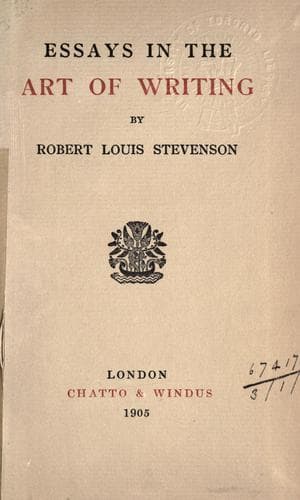
Essays in the Art of WritingStevenson, Robert Louis
History
Essays in the Art of Writing
Stevenson, Robert Louis
Authorship; Literature -- History and criticism; Stevenson, Robert Louis, 1850-1894 -- Authorship
I suppose, when I am done, I shall find that I have forgotten much that
was most influential, as I see already I have forgotten Thoreau, and
Hazlitt, whose paper ‘On the Spirit of Obligations’ was a turning-point
in my life, and Penn, whose little book of aphorisms had a brief but
strong effect on me, and Mitford’s _Tales of Old Japan_, wherein I
learned for the first time the proper attitude of any rational man to his
country’s laws—a secret found, and kept, in the Asiatic islands. That I
should commemorate all is more than I can hope or the Editor could ask.
It will be more to the point, after having said so much upon improving
books, to say a word or two about the improvable reader. The gift of
reading, as I have called it, is not very common, nor very generally
understood. It consists, first of all, in a vast intellectual
endowment—a free grace, I find I must call it—by which a man rises to
understand that he is not punctually right, nor those from whom he
differs absolutely wrong. He may hold dogmas; he may hold them
passionately; and he may know that others hold them but coldly, or hold
them differently, or hold them not at all. Well, if he has the gift of
reading, these others will be full of meat for him. They will see the
other side of propositions and the other side of virtues. He need not
change his dogma for that, but he may change his reading of that dogma,
and he must supplement and correct his deductions from it. A human
truth, which is always very much a lie, hides as much of life as it
displays. It is men who hold another truth, or, as it seems to us,
perhaps, a dangerous lie, who can extend our restricted field of
knowledge, and rouse our drowsy consciences. Something that seems quite
new, or that seems insolently false or very dangerous, is the test of a
reader. If he tries to see what it means, what truth excuses it, he has
the gift, and let him read. If he is merely hurt, or offended, or
exclaims upon his author’s folly, he had better take to the daily papers;
he will never be a reader.
Public-domain text, read in full here on John Shaqi.
Reviews
Reviews
No reviews yet
Be the first to share your thoughts on this work.
Join the Discussion
Join the discussion
Sign in to leave a comment or review.
Sign InorCreate an account