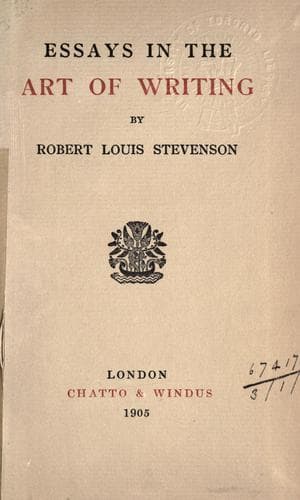
Essays in the Art of WritingStevenson, Robert Louis
History
Essays in the Art of Writing
Stevenson, Robert Louis
Authorship; Literature -- History and criticism; Stevenson, Robert Louis, 1850-1894 -- Authorship
And here, with the aptest illustrative force, after I have laid down my
part-truth, I must step in with its opposite. For, after all, we are
vessels of a very limited content. Not all men can read all books; it is
only in a chosen few that any man will find his appointed food; and the
fittest lessons are the most palatable, and make themselves welcome to
the mind. A writer learns this early, and it is his chief support; he
goes on unafraid, laying down the law; and he is sure at heart that most
of what he says is demonstrably false, and much of a mingled strain, and
some hurtful, and very little good for service; but he is sure besides
that when his words fall into the hands of any genuine reader, they will
be weighed and winnowed, and only that which suits will be assimilated;
and when they fall into the hands of one who cannot intelligently read,
they come there quite silent and inarticulate, falling upon deaf ears,
and his secret is kept as if he had not written.
A NOTE ON REALISM {93}
Style is the invariable mark of any master; and for the student who does
not aspire so high as to be numbered with the giants, it is still the one
quality in which he may improve himself at will. Passion, wisdom,
creative force, the power of mystery or colour, are allotted in the hour
of birth, and can be neither learned nor simulated. But the just and
dexterous use of what qualities we have, the proportion of one part to
another and to the whole, the elision of the useless, the accentuation of
the important, and the preservation of a uniform character from end to
end—these, which taken together constitute technical perfection, are to
some degree within the reach of industry and intellectual courage. What
to put in and what to leave out; whether some particular fact be
organically necessary or purely ornamental; whether, if it be purely
ornamental, it may not weaken or obscure the general design; and finally,
whether, if we decide to use it, we should do so grossly and notably, or
in some conventional disguise: are questions of plastic style continually
rearising. And the sphinx that patrols the highways of executive art has
no more unanswerable riddle to propound.
Public-domain text, read in full here on John Shaqi.
Reviews
Reviews
No reviews yet
Be the first to share your thoughts on this work.
Join the Discussion
Join the discussion
Sign in to leave a comment or review.
Sign InorCreate an account