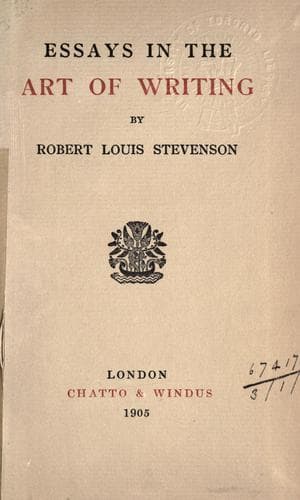
Essays in the Art of WritingStevenson, Robert Louis
History
Essays in the Art of Writing
Stevenson, Robert Louis
Authorship; Literature -- History and criticism; Stevenson, Robert Louis, 1850-1894 -- Authorship
The web, then, or the pattern: a web at once sensuous and logical, an
elegant and pregnant texture: that is style, that is the foundation of
the art of literature. Books indeed continue to be read, for the
interest of the fact or fable, in which this quality is poorly
represented, but still it will be there. And, on the other hand, how
many do we continue to peruse and reperuse with pleasure whose only merit
is the elegance of texture? I am tempted to mention Cicero; and since
Mr. Anthony Trollope is dead, I will. It is a poor diet for the mind, a
very colourless and toothless ‘criticism of life’; but we enjoy the
pleasure of a most intricate and dexterous pattern, every stitch a model
at once of elegance and of good sense; and the two oranges, even if one
of them be rotten, kept dancing with inimitable grace.
Up to this moment I have had my eye mainly upon prose; for though in
verse also the implication of the logical texture is a crowning beauty,
yet in verse it may be dispensed with. You would think that here was a
death-blow to all I have been saying; and far from that, it is but a new
illustration of the principle involved. For if the versifier is not
bound to weave a pattern of his own, it is because another pattern has
been formally imposed upon him by the laws of verse. For that is the
essence of a prosody. Verse may be rhythmical; it may be merely
alliterative; it may, like the French, depend wholly on the (quasi)
regular recurrence of the rhyme; or, like the Hebrew, it may consist in
the strangely fanciful device of repeating the same idea. It does not
matter on what principle the law is based, so it be a law. It may be
pure convention; it may have no inherent beauty; all that we have a right
to ask of any prosody is, that it shall lay down a pattern for the
writer, and that what it lays down shall be neither too easy nor too
hard. Hence it comes that it is much easier for men of equal facility to
write fairly pleasing verse than reasonably interesting prose; for in
prose the pattern itself has to be invented, and the difficulties first
created before they can be solved. Hence, again, there follows the
peculiar greatness of the true versifier: such as Shakespeare, Milton,
and Victor Hugo, whom I place beside them as versifier merely, not as
poet. These not only knit and knot the logical texture of the style with
all the dexterity and strength of prose; they not only fill up the
pattern of the verse with infinite variety and sober wit; but they give
us, besides, a rare and special pleasure, by the art, comparable to that
of counterpoint, with which they follow at the same time, and now
contrast, and now combine, the double pattern of the texture and the
verse. Here the sounding line concludes; a little further on, the
well-knit sentence; and yet a little further, and both will reach their
solution on the same ringing syllable. The best that can be offered by
Public-domain text, read in full here on John Shaqi.
Reviews
Reviews
No reviews yet
Be the first to share your thoughts on this work.
Join the Discussion
Join the discussion
Sign in to leave a comment or review.
Sign InorCreate an account