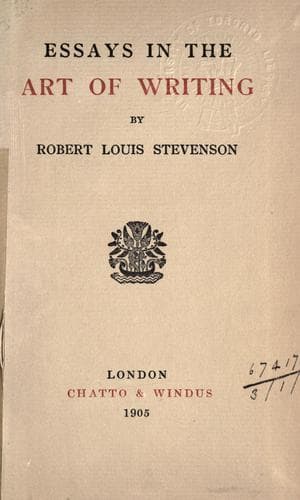
Essays in the Art of WritingStevenson, Robert Louis
History
Essays in the Art of Writing
Stevenson, Robert Louis
Authorship; Literature -- History and criticism; Stevenson, Robert Louis, 1850-1894 -- Authorship
the best writer of prose is to show us the development of the idea and
the stylistic pattern proceed hand in hand, sometimes by an obvious and
triumphant effort, sometimes with a great air of ease and nature. The
writer of verse, by virtue of conquering another difficulty, delights us
with a new series of triumphs. He follows three purposes where his rival
followed only two; and the change is of precisely the same nature as that
from melody to harmony. Or if you prefer to return to the juggler,
behold him now, to the vastly increased enthusiasm of the spectators,
juggling with three oranges instead of two. Thus it is: added
difficulty, added beauty; and the pattern, with every fresh element,
becoming more interesting in itself.
Yet it must not be thought that verse is simply an addition; something is
lost as well as something gained; and there remains plainly traceable, in
comparing the best prose with the best verse, a certain broad distinction
of method in the web. Tight as the versifier may draw the knot of logic,
yet for the ear he still leaves the tissue of the sentence floating
somewhat loose. In prose, the sentence turns upon a pivot, nicely
balanced, and fits into itself with an obtrusive neatness like a puzzle.
The ear remarks and is singly gratified by this return and balance; while
in verse it is all diverted to the measure. To find comparable passages
is hard; for either the versifier is hugely the superior of the rival,
or, if he be not, and still persist in his more delicate enterprise, he
fails to be as widely his inferior. But let us select them from the
pages of the same writer, one who was ambidexter; let us take, for
instance, Rumour’s Prologue to the Second Part of _Henry IV._, a fine
flourish of eloquence in Shakespeare’s second manner, and set it side by
side with Falstaff’s praise of sherris, act iv. scene iii.; or let us
compare the beautiful prose spoken throughout by Rosalind and Orlando;
compare, for example, the first speech of all, Orlando’s speech to Adam,
with what passage it shall please you to select—the Seven Ages from the
same play, or even such a stave of nobility as Othello’s farewell to war;
and still you will be able to perceive, if you have an ear for that class
of music, a certain superior degree of organisation in the prose; a
compacter fitting of the parts; a balance in the swing and the return as
of a throbbing pendulum. We must not, in things temporal, take from
those who have little, the little that they have; the merits of prose are
inferior, but they are not the same; it is a little kingdom, but an
independent.
Public-domain text, read in full here on John Shaqi.
Reviews
Reviews
No reviews yet
Be the first to share your thoughts on this work.
Join the Discussion
Join the discussion
Sign in to leave a comment or review.
Sign InorCreate an account