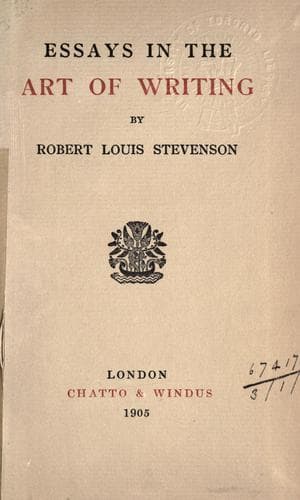
Essays in the Art of WritingStevenson, Robert Louis
History
Essays in the Art of Writing
Stevenson, Robert Louis
Authorship; Literature -- History and criticism; Stevenson, Robert Louis, 1850-1894 -- Authorship
But again, four is not necessary. We do not, indeed, find verses in six
groups, because there is not room for six in the ten syllables; and we do
not find verses of two, because one of the main distinctions of verse
from prose resides in the comparative shortness of the group; but it is
even common to find verses of three. Five is the one forbidden number;
because five is the number of the feet; and if five were chosen, the two
patterns would coincide, and that opposition which is the life of verse
would instantly be lost. We have here a clue to the effect of
polysyllables, above all in Latin, where they are so common and make so
brave an architecture in the verse; for the polysyllable is a group of
Nature’s making. If but some Roman would return from Hades (Martial, for
choice), and tell me by what conduct of the voice these thundering verses
should be uttered—‘_Aut Lacedæmonium Tarentum_,’ for a case in point—I
feel as if I should enter at last into the full enjoyment of the best of
human verses.
But, again, the five feet are all iambic, or supposed to be; by the mere
count of syllables the four groups cannot be all iambic; as a question of
elegance, I doubt if any one of them requires to be so; and I am certain
that for choice no two of them should scan the same. The singular beauty
of the verse analysed above is due, so far as analysis can carry us,
part, indeed, to the clever repetition of L, D, and N, but part to this
variety of scansion in the groups. The groups which, like the bar in
music, break up the verse for utterance, fall uniambically; and in
declaiming a so-called iambic verse, it may so happen that we never utter
one iambic foot. And yet to this neglect of the original beat there is a
limit.
‘Athens, the eye of Greece, mother of arts,’ {24}
is, with all its eccentricities, a good heroic line; for though it
scarcely can be said to indicate the beat of the iamb, it certainly
suggests no other measure to the ear. But begin
‘Mother Athens, eye of Greece,’
or merely ‘Mother Athens,’ and the game is up, for the trochaic beat has
been suggested. The eccentric scansion of the groups is an adornment;
but as soon as the original beat has been forgotten, they cease
implicitly to be eccentric. Variety is what is sought; but if we destroy
the original mould, one of the terms of this variety is lost, and we fall
back on sameness. Thus, both as to the arithmetical measure of the
verse, and the degree of regularity in scansion, we see the laws of
prosody to have one common purpose: to keep alive the opposition of two
schemes simultaneously followed; to keep them notably apart, though still
coincident; and to balance them with such judicial nicety before the
reader, that neither shall be unperceived and neither signally prevail.
Public-domain text, read in full here on John Shaqi.
Reviews
Reviews
No reviews yet
Be the first to share your thoughts on this work.
Join the Discussion
Join the discussion
Sign in to leave a comment or review.
Sign InorCreate an account