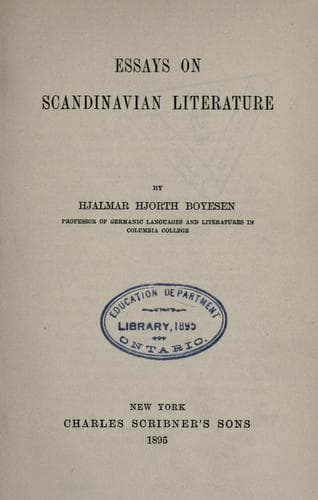
Essays on Scandinavian LiteratureBoyesen, Hjalmar Hjorth
History
Essays on Scandinavian Literature
Boyesen, Hjalmar Hjorth
Authors, Scandinavian; Scandinavian literature -- History and criticism
Peter Amadeus Atterbom, the leader of the Phosphorists, replied with
much moderation and good sense to the obvious reflections upon his
school which this poem contained. He intimates plainly enough that
Tegner's philosophy of life, in so far as it ignores sin and sorrow,
which are too real to be banished by song, is a hopelessly shallow one.
"The undissolved dissonances," he says, "in the sense in which Mr.
Tegner uses the expression, certainly betray a disease of the soul, but
this disease is not peculiar to a temperament which is fostered by a
personal emotional affinity for lugubrious topics and ideas given by
birth and developed by circumstances; but it is inherent in the weakness
(which at times doubtless surprises even the strongest ...) of desiring
to set up its sorrowful view of the world as a theory, and treat it as
absolutely true and fundamentally valid for all. Sorrow, as such, is no
more a diseased state than is joy; both are alike primordial, necessary,
indispensable elements and halves of human life. Who would venture to
assert that the day might dispense with the night? And does not the
latter's glorious starry sky rival in majesty (though different in kind)
the former's bright and dazzling blitheness?"
The fact was that Tegner's cheery sun-worship was as much temperamental
as was Atterbom's sentimental reveries and nocturnal melancholy. The
Phosphorist is unquestionably right, however, in asserting that as a
theory of life the one is as limited and imperfect as the other. It was
because of the abhorrence of all the darker phases of existence that
Tegner's bright Hellenic muse never struck those notes which thrill
with deepest resonance through the human heart. Tegner's acquaintance
with suffering during the early part of his career was chiefly a
literary one, and like Goethe he went far out of his way to avoid the
sight of it. As there can be no victory without combat--no laurel
without dust--the Mount of Transfiguration is not reached except through
the valley of the Shadow of Death.
There are, however, many fair flowers to be plucked in Tempe and the
blooming vales of Arcady. Goethe had in 1798 published "Hermann and
Dorothea," the form of which was Greek, though the theme was Teutonic;
and Tegner's "Children of the Lord's Supper" (1820), which Longfellow
has translated so admirably into English, derived its inspiration
primarily from the German idyl:
"Pentecost, day of rejoicing, had come, the church of the village
Stood, gleaming white in the morning sheen. On the spire of the belfry,
Decked with a brazen cock, the friendly flames of the spring sun
Glanced like the tongues of fire beheld by Apostles aforetime."
Public-domain text, read in full here on John Shaqi.
Reviews
Reviews
No reviews yet
Be the first to share your thoughts on this work.
Elsewhere in the archive
Join the Discussion
Join the discussion
Sign in to leave a comment or review.
Sign InorCreate an account