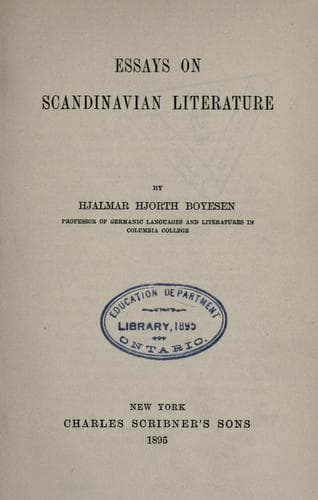
Essays on Scandinavian LiteratureBoyesen, Hjalmar Hjorth
History
Essays on Scandinavian Literature
Boyesen, Hjalmar Hjorth
Authors, Scandinavian; Scandinavian literature -- History and criticism
Thus run the beautiful, stately hexameters, which, whatever cavilling
critics may say, are delightfully adapted for epic narrative in any
fairly polysyllabic language. And Swedish, which is the most sonorous of
all Germanic tongues, and full of Gothic strength, produces the most
delectable effects in the long, rolling line of slow-marching dactyls
and spondees. The tempered realism of Tegner, which shuns all that is
harsh and trite, accords well with the noble classical verse. He employs
it, as it were, to dignify his homely tale, as Raphael draped the
fishermen of Galilee in the flowing robes of Greek philosophers. The
description of the church, the rustic youth, and the patriarchal
clergyman has, however, the note of experience and the touch of earth
which we miss in the more declamatory passages. If, however, declamation
is anywhere in place it is in the three orations of the rural parson,
which occupy the larger portion of the poem. It is all very lovely and
edifying; full of sacred eloquence and a grand amplitude of phrase which
is distinctly clerical.
The romantic tale of "Axel" (1822), modelled after Byron's narrative
poems, rejoiced in a greater popularity, in spite of the carping
criticism with which it was received by the _Svensk Litteratur-Tidning,_
the organ of the Phosphorists. Though, to be sure, the merits of the
poem are largely ignored in this review, it is undeniable that the
faults which are emphasized do exist. First, the frequent violations of
probability (which, by the way, ought not to have been so offensive to a
romanticist) draw tremendous draughts upon the reader's credulity; and
secondly, the lavish magnificence of imagery rarely adds to the
vividness of the situations, but rather obscures and confuses them. It
reminds one of a certain style of barocque architecture in which the
rage for ornamentation twists every line into a scroll or spiral or
arabesque, until whatever design there originally was is lost in a riot
of decoration. The metaphors exist for their own sake, and are in nowise
subordinate to the themes which they profess to illustrate. Take, for
instance, the oft-quoted passage:
"The night drew near, and in the west
Upon its couch lay Evening dreaming,
And silent, like the priests of Egypt,
The stars pursued their radiant paths,
And earth stood in the starry eve,
As blissful as a bride who stands,
The garland in her dusky hair,
Beneath the baldaquin and blushes.
Tired of the games of day, and warm,
The Naiad rested, still and smiling,
The glow of evening shone resplendent,
A gorgeous rose upon her breast;
And merry Cupid, who had slept
When sun was high, awoke and rode
Upon the moonbeams up and down,
With bow and arrow, through the forest."
Public-domain text, read in full here on John Shaqi.
Reviews
Reviews
No reviews yet
Be the first to share your thoughts on this work.
Elsewhere in the archive
Join the Discussion
Join the discussion
Sign in to leave a comment or review.
Sign InorCreate an account