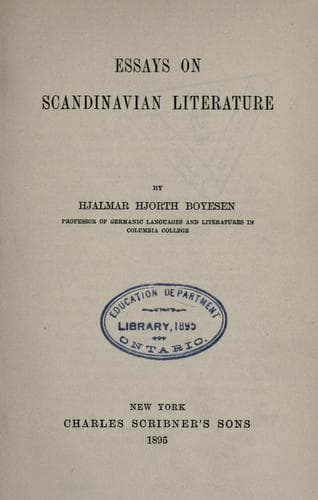
Essays on Scandinavian LiteratureBoyesen, Hjalmar Hjorth
History
Essays on Scandinavian Literature
Boyesen, Hjalmar Hjorth
Authors, Scandinavian; Scandinavian literature -- History and criticism
There was at that time a general revival of interest in the so-called
saga-age. The Danish poet, Oehlenschlaeger, had published his old-Norse
cycle of poems, "Helge," which aroused a sympathetic reverberation in
Tegner's mind. The idea took possession of him that here was a theme
which lay well within the range of his own voice, and full of alluring
possibilities. Accordingly he chose the ancient "Saga of Frithjof the
Bold," and resolved to embody in it all the characteristic features of
the old heroic life. And what Oehlenschlaeger had attempted to do, and
partly succeeded in doing, he accomplished with a completeness of
success which was a surprise to himself. No sooner had "Iduna," the
organ of the Gothic League, published the first nine cantos (1821), than
all Sweden resounded with enthusiastic applause; and even from beyond
the boundaries of the fatherland came voices of praise. When the
completed poem appeared in book-form, it was translated into all
civilized languages, and everywhere, in spite of the translators'
shortcomings, it was hailed with delight. Not only England, France, and
Germany hastened to appropriate it, but even in Spain, Greece, and
Russia tears were shed over "Ingeborg's Lament," and tender bosoms
palpitated with sympathy for Frithjof's sorrows. I know a dozen English
translations of "Frithjof's Saga" (a friend of mine, who is a
bibliophile, assures me that the exact number is at present twenty-one),
and of German versions the number is not very much less. A Norwegian (or
rather Danish) rendering was presented to me on my twelfth birthday; and
the sentiment which then most forcibly appealed to me was, as I vividly
remember, embodied in the following verse, in which Bjoern chides his
friend's grief for the loss of his beloved:
"Frithjof, 'tis time for your folly's abating;
Sigh and lament for a woman's loss:
Earth is, alas, too full of such dross;
One may be lost, still a thousand are waiting.
Say but the word, of such goods I will bring
Quickly a cargo--the Southland can spare them,
Bed as the rose, mild as lambs in the spring;
Then we'll cast lots, or as brothers we'll share them."[37]
[37] Holcomb's translation.
It was not the unconscious humor of this proposition which struck me the
most in those days; but it was the bluff frankness of the gruff old
viking which then seemed truly admirable. In fact, I am not sure but
that Bjoern appeared to me a more sympathetic figure than Frithjof. But a
little later it dawned upon me that his utter lack of chivalry was
rather revolting; and I began to marvel at my former admiration. At
fourteen the following verse (which at twelve was charmingly heroic)
caused me to revise my opinion of Bjoern:
"Good! to King Ring it shall be my glad duty
Something to teach of a wronged viking's power;
Fire we his palace at midnight's still hour,
Scorch the old graybeard and bear off the beauty."
Public-domain text, read in full here on John Shaqi.
Reviews
Reviews
No reviews yet
Be the first to share your thoughts on this work.
Elsewhere in the archive
Join the Discussion
Join the discussion
Sign in to leave a comment or review.
Sign InorCreate an account