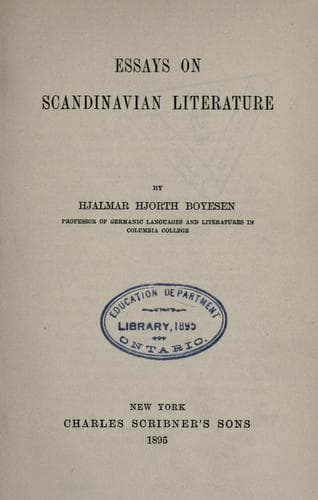
Essays on Scandinavian LiteratureBoyesen, Hjalmar Hjorth
History
Essays on Scandinavian Literature
Boyesen, Hjalmar Hjorth
Authors, Scandinavian; Scandinavian literature -- History and criticism
For all that, Bjoern with his rough speech and hearty delight in fighting
and drinking, is far truer to the spirit of the old heroic age than is
Frithjof with his sentimentality and lovesick reveries. This verse, for
instance, is replete with the briny breath of the northern main. The
north wind blows through it:
"Good is the sea, your complaining you squander,
Freedom and joy on the sea flourish best.
He never knoweth effeminate rest
Who on the billows delighteth to wander.
When I am old, to the green-growing land
I, too, will cling, with the grass for my pillow.
Now I will drink and will fight with free hand,
Now I'll enjoy my own sorrow-free billow."
I might continue in the autobiographical vein; but must forbear. For
there is a period in the life of every young Norseman when, untroubled
by its anachronism, he glories in Frithjof's melancholy mooning, his
praise of Ingeborg, his misanthropy, and all the manifold moods of love
so enchantingly expressed in Tegner's melodious verse.
When a book acquires this significance as an expression of the typical
experience in the lives of thousands, the critical muse can but join in
the general chorus, and find profound reasons for the universal praise.
In the case of "Frithjof's Saga" this is not a difficult matter. From
beginning to end the poem has a lyrical intensity which sets the mind
vibrating with a responsive emotion. It is not a coldly impersonal epic,
recounting remote heroic events; but there is a deeply personal note in
it, which has that nameless moving quality--_la note emue_, as the
French call it--which brings the tear to your eye, and sends a delicious
breeze through your nerves. All that, to be sure, or nearly all of it,
evaporates in translation; for no more than you can transfer the
exquisite dewy intactness of the lily to canvas can you transfer the
rapturous melody of noble verse into an alien tongue. The subtlest
harmonies--those upon which the thrill depends--are invariably lost. If
Longfellow, instead of giving us two cantos, had translated the whole
poem, we should, at least, have possessed an English version which would
have afforded us some conception of the charm of the renowned original.
Public-domain text, read in full here on John Shaqi.
Reviews
Reviews
No reviews yet
Be the first to share your thoughts on this work.
Elsewhere in the archive
Join the Discussion
Join the discussion
Sign in to leave a comment or review.
Sign InorCreate an account