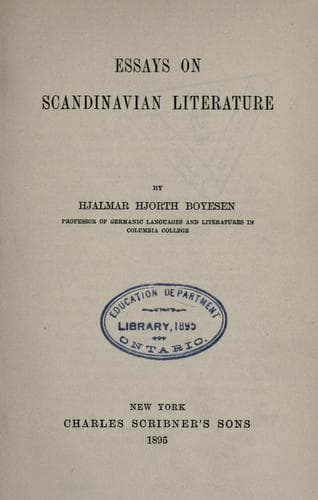
Essays on Scandinavian LiteratureBoyesen, Hjalmar Hjorth
History
Essays on Scandinavian Literature
Boyesen, Hjalmar Hjorth
Authors, Scandinavian; Scandinavian literature -- History and criticism
The objections to "Frithjof's Saga" which have been urged by numerous
critics may all be admitted as more or less valid; yet something remains
which will account for its astounding popularity. Tegner at the time
when he was singing of Frithjof's and Ingeborg's love was himself
suffering from a consuming but unrequited passion. The strong, warm
pulse of life which throbs in Frithjof's wrath, defiance, and scorn, and
in his deep and manly tenderness is the poet's own. It marks but the
rhythm of his own tumultuous heart-beat. It is altogether an unhappy
chapter, which his biographer has vainly striven to suppress. There was
among his acquaintance in Lund a certain Mrs. Palm, toward whom he felt
drawn with an irresistible half-demonic force. Beyond this fact we know
nothing of the lady, except that she was handsome, cultivated, and
well-connected. Whatever approaches Tegner may have made toward her (and
it is not known of what nature they were) she appears to have repelled;
and the poet, though fighting desperately against his growing
infatuation, wore out his splendid vitality in the conflict of emotions
which the unhappy relation occasioned. He became a prey to the most
terrible melancholy, and a misanthropy of the deepest hue spread its
sombre veil over the world which hitherto had given to him its brightest
smile. The dread of insanity became an _idee fixe_ with him; and the
pathetic cry, "God preserve my reason," rings again and again through
his private correspondence. One of his brothers was insane; and he
fancied that there must be a taint in his blood which menaced him with
the same tragic doom.
Happily, he could as yet conjure the storm. It hung threateningly on the
horizon of his mind, with mutterings of thunder and stray flashes of
lightning. But his poetic bark still sped along with full sails, bravely
breasting the waves.
"Und wenn der Mensch in seiner Qual verstummt
Gab mir ein Gott zu sagen was ich leide,"
says Goethe. And this divine gift of saying, or, better still, of
singing, what he suffered made Tegner, during this period, master of his
sufferings. They did not overwhelm him and ruin his usefulness. On the
contrary, these were the most active and fruitful years of his life. But
it was the deep agitation which possessed him--it was the suppressed
tumult of his strong soul which vibrated through "Frithjof" and which
imparted to it that vital quality, that moving ring which arouses the
deeper feelings in the human heart.
Public-domain text, read in full here on John Shaqi.
Reviews
Reviews
No reviews yet
Be the first to share your thoughts on this work.
Elsewhere in the archive
Join the Discussion
Join the discussion
Sign in to leave a comment or review.
Sign InorCreate an account