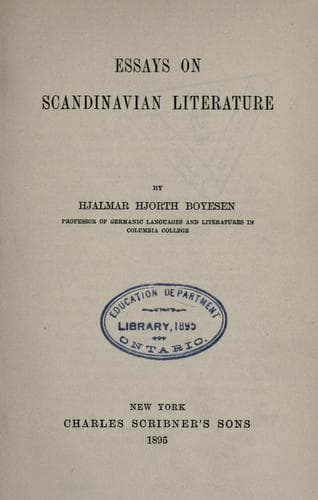
Essays on Scandinavian LiteratureBoyesen, Hjalmar Hjorth
History
Essays on Scandinavian Literature
Boyesen, Hjalmar Hjorth
Authors, Scandinavian; Scandinavian literature -- History and criticism
Archaeologically the poem was not correct, and was not meant to be.
Tegner distinctly disclaimed the intention of producing a historically
accurate picture of the saga age; and all criticism censuring the
modernness of Frithjofs and Ingeborg's sentiments is, therefore,
according to his idea, wide of the mark. I do not quite agree with his
point of view, but will state his argument. For the historical Frithjof,
as he is represented in the ancient Norse saga bearing his name, Tegner
cared but little. What he wished to do was to give a poetic presentation
of the old heroic life, and he chose Frithjof as his representative of
this age because he united in himself so many of its characteristics:
"In the saga much occurs which is very grand and heroic, and hence
valid for all times, which both might and ought to be retained;
but, on the other hand, a great deal occurs which is rough, savage,
barbarous; and this had either to be entirely eliminated, or at
least materially softened. Up to a certain degree it therefore
became necessary to modernize; but the difficulty was to find the
golden mean. On the one hand, the poem ought not to offend too much
our more refined manners and gentler modes of thought; but, on the
other hand, the natural quality, the freshness, the truth to nature
ought not to be sacrificed."
Tegner fancies he has solved this problem by retaining in Frithjof the
fundamental traits of all heroism, viz., nobility, magnanimity, courage;
but at the same time nationalizing them by giving them a distinctly
Scandinavian tinge. And this he has done by making his hero almost
wantonly defiant, stubborn, pugnacious. As Ingeborg, lamenting his
fierce pugnacity, and yet glorying in it, says:
"How glad, how stubborn, and how full of hope!
The point he setteth of his trusty sword
Against the breast of Fate and crieth, Thou must yield."
"Another peculiarity of the Norseman's character is a certain
tendency to sadness and melancholy which is habitual with all
deeper natures. An elegiac tone pervades all our old national
melodies, and, generally speaking, all that is of significance in
our history; for it rises from the very bottom of the nation's
heart. There is a certain joyousness (commonly attributed to the
French) which in the last instance is only levity. But the
joyousness of the North is fundamentally serious; for which reason
I have in Frithjof endeavored to give a hint of this brooding
melancholy in his repentance of the unintentional burning of the
temple, his brooding fear of Balder,
"Who sits in the sky, and the thoughts he sends down,
Which forever are clouding my mind."
Public-domain text, read in full here on John Shaqi.
Reviews
Reviews
No reviews yet
Be the first to share your thoughts on this work.
Elsewhere in the archive
Join the Discussion
Join the discussion
Sign in to leave a comment or review.
Sign InorCreate an account