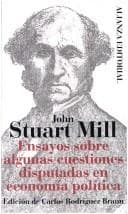
Essays on some unsettled Questions of Political Economy — John Shaqi
Essays on some unsettled Questions of Political EconomyMill, John Stuart
PhilosophyPhilosophy
Essays on some unsettled Questions of Political Economy
Mill, John Stuart
Economics
What a country wants to make it richer, is never consumption, but
production. Where there is the latter, we may be sure that there is no
want of the former. To produce, implies that the producer desires to
consume; why else should he give himself useless labour? He may not wish
to consume what he himself produces, but his motive for producing and
selling is the desire to buy. Therefore, if the producers generally
produce and sell more and more, they certainly also buy more and more.
Each may not want more of what he himself produces, but each wants more
of what some other produces; and, by producing what the other wants,
hopes to obtain what the other produces. There will never, therefore, be
a greater quantity produced, of commodities in general, than there are
consumers for. But there may be, and always are, abundance of persons
who have the inclination to become consumers of some commodity, but are
unable to satisfy their wish, because they have not the means of
producing either that, or anything to give in exchange for it. The
legislator, therefore, needs not give himself any concern about
consumption. There will always be consumption for everything which can
be produced, until the wants of all who possess the means of producing
are completely satisfied, and then production will not increase any
farther. The legislator has to look solely to two points: that no
obstacle shall exist to prevent those who have the means of producing,
from employing those means as they find most for their interest; and
that those who have not at present the means of producing, to the extent
of their desire to consume, shall have every facility afforded to their
acquiring the means, that, becoming producers, they may be enabled to
consume.
These general principles are now well understood by almost all who
profess to have studied the subject, and are disputed by few except
those who ostentatiously proclaim their contempt for such studies. We
touch upon the question, not in the hope of rendering these fundamental
truths clearer than they already are, but to perform a task, so useful
and needful, that it is to be wished it were oftener deemed part of the
business of those who direct their assaults against ancient prejudices,
--that of seeing that no scattered particles of important truth are
buried and lost in the ruins of exploded error. Every prejudice, which
has long and extensively prevailed among the educated and intelligent,
must certainly be borne out by some strong appearance of evidence; and
when it is found that the evidence does not prove the received
conclusion, it is of the highest importance to see what it does prove.
If this be thought not worth inquiring into, an error conformable to
appearances is often merely exchanged for an error contrary to
appearances; while, even if the result be truth, it is paradoxical
truth, and will have difficulty in obtaining credence while the false
appearances remain.
Public-domain text, read in full here on John Shaqi.
Reviews
Reviews
No reviews yet
Be the first to share your thoughts on this work.
Join the Discussion
Join the discussion
Sign in to leave a comment or review.
Sign InorCreate an account