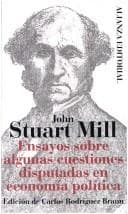
Essays on some unsettled Questions of Political Economy — John Shaqi
Essays on some unsettled Questions of Political EconomyMill, John Stuart
PhilosophyPhilosophy
Essays on some unsettled Questions of Political Economy
Mill, John Stuart
Economics
Let us therefore inquire into the nature of the appearances, which gave
rise to the belief that a great demand, a brisk circulation, a rapid
consumption (three equivalent expressions), are a cause of national
prosperity.
If every man produced for himself, or with his capital employed others
to produce, everything which he required, customers and their wants
would be a matter of profound indifference to him. He would be rich, if
he had produced and stored up a large supply of the articles which he
was likely to require; and poor, if he had stored up none at all, or not
enough to last until he could produce more.
The case, however, is different after the separation of employments. In
civilized society, a single producer confines himself to the production
of one commodity, or a small number of commodities; and his affluence
depends, not solely upon the quantity of his commodity which he has
produced and laid in store, but upon his success in finding purchasers
for that commodity.
It is true, therefore, of every particular producer or dealer, that
a great demand, a brisk circulation, a rapid consumption, of the
commodities which he sells at his shop or produces in his manufactory,
is important to him. The dealer whose shop is crowded with customers,
who can dispose of a product almost the very moment it is completed,
makes large profits, while his next neighbour, with an equal capital
but fewer customers, gains comparatively little.
It was natural that, in this case, as in a hundred others, the analogy
of an individual should be unduly applied to a nation: as it has been
concluded that a nation generally gains in wealth by the conquest of a
province, because an individual frequently does so by the acquisition of
an estate; and as, because an individual estimates his riches by the
quantity of money which he can command, it was long deemed an excellent
contrivance for enriching a country, to heap up artificially the
greatest possible quantity of the precious metals within it.
Let us examine, then, more closely than has usually been done, the case
from which the misleading analogy is drawn. Let us ascertain to what
extent the two cases actually resemble; what is the explanation of the
false appearance, and the real nature of the phenomenon which, being
seen indistinctly, has led to a false conclusion.
* * * * *
Public-domain text, read in full here on John Shaqi.
Reviews
Reviews
No reviews yet
Be the first to share your thoughts on this work.
Join the Discussion
Join the discussion
Sign in to leave a comment or review.
Sign InorCreate an account