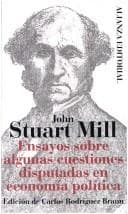
Essays on some unsettled Questions of Political Economy — John Shaqi
Essays on some unsettled Questions of Political EconomyMill, John Stuart
PhilosophyPhilosophy
Essays on some unsettled Questions of Political Economy
Mill, John Stuart
Economics
The remainder of what Mr. Ricardo has done for the philosophical
exposition of the principles of foreign trade, is to shew, that the
truth of the propositions now recapitulated is not affected by the
introduction of money as a medium of exchange; the precious metals
always tending to distribute themselves in such a manner throughout the
commercial world, that every country shall import all that it would have
imported, and export all that it would have exported, if exchanges had
taken place, as in the example above supposed, by barter.
To this branch of the subject we shall, in the sequel of this essay,
return. At present it will be more convenient that we should continue to
suppose, that exchanges take place by the direct trucking of one
commodity against another.
It is established, that the advantage which two countries derive from
trading with each other, results from the more advantageous employment
which thence arises, of the labour and capital--for shortness let us say
the labour--of both jointly. The circumstances are such, that if each
country confines itself to the production of one commodity, there is a
greater total return to the labour of both together; and this increase
of produce forms the whole of what the two countries taken together gain
by the trade.
It is the purpose of the present essay to inquire, in what proportion
the increase of produce, arising from the saving of labour, is divided
between the two countries.
This question was not entered into by Mr. Ricardo, whose attention was
engrossed by far more important questions, and who, having a science to
create, had not time, or room, to occupy himself with much more than the
leading principles. When he had done enough to enable any one who came
after him, and who took the necessary pains, to do all the rest, he was
satisfied. He very rarely followed out the principles of the science
into the ramifications of their consequences. But we believe that to no
one, who has thoroughly entered into the spirit of his discoveries, will
even the minutiae of the science offer any difficulty but that which is
constituted by the necessity of patience and circumspection in tracing
principles to their results.
Mr. Ricardo, while intending to go no further into the question of the
advantage of foreign trade than to show what it consisted of, and under
what circumstances it arose, unguardedly expressed himself as if each of
the two countries making the exchange separately gained the whole of the
difference between the comparative costs of the two commodities in one
country and in the other. But, the whole gain of both countries
together, consisting in the saving of labour; and the saving of labour
being exactly equal to the difference between the costs, in the two
countries, of the one commodity as compared with the other; the two
countries taken together gain no more than this difference: and if
either country gains the whole of it, the other country derives no
advantage from the trade.
Public-domain text, read in full here on John Shaqi.
Reviews
Reviews
No reviews yet
Be the first to share your thoughts on this work.
Join the Discussion
Join the discussion
Sign in to leave a comment or review.
Sign InorCreate an account