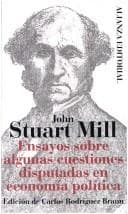
Essays on some unsettled Questions of Political EconomyMill, John Stuart
PhilosophyPhilosophy
Essays on some unsettled Questions of Political Economy
Mill, John Stuart
Economics
Suppose, for example, that 10 yards of broad cloth cost in England as
much labour as 15 yards of linen, and in Germany as much as 20. If
England sends 10 yards of broad cloth to Germany, and is able to
exchange them for linen according to the German cost of production, she
will get 20 yards of linen, with a quantity of labour with which she
could not have produced more than 15; and will gain, therefore, 5 yards
on every 15, or 33-1/3 per cent. But in this case Germany would obtain
only 10 yards of cloth for 20 of linen. Now, 10 yards of cloth cost
exactly the same quantity of labour in Germany as 20 of linen; Germany,
therefore, derives no advantage from the trade, more than she would
possess if it did not exist.
So, on the other hand, if Germany sends 15 yards of linen to England,
and finding the relative value of the two articles in that country
determined by the English costs of production, is enabled to purchase
with 35 yards of linen 10 yards of cloth; Germany now gains 5 yards,
just as England did before,--for with 15 yards of linen she purchases 10
yards of cloth, when to produce these 10 yards she must have employed as
much labour as would have enabled her to produce 20 yards of linen. But
in this case England would gain nothing: she would only obtain, for her
10 yards of cloth, 15 yards of linen, which is exactly the comparative
cost at which she could have produced them.
This, which was not an error, but a mere oversight of Mr. Ricardo,
arising from his having left the question of the division of the
advantage entirely unnoticed, was first corrected in the third edition
of Mr. Mill's _Elements of Political Economy_. It can hardly, however,
be said that Mr. Mill has prosecuted the inquiry any further; which,
indeed, would have been quite as inconsistent with the nature of his
plan as of Mr. Ricardo's.
1. When the trade is established between the two countries, the two
commodities will exchange for each other at the same rate of interchange
in both countries--bating the cost of carriage, of which, for the present,
it will be more convenient to omit the consideration. Supposing, therefore,
for the sake of argument, that the carriage of the commodities from one
country to another could be effected without labour and without cost, no
sooner would the trade be opened than, it is self-evident, the value of
the two commodities, estimated in each other, would come to a level in
both countries.
If we knew what this level would be, we should know in what proportion
the two countries would share the advantage of the trade.
Public-domain text, read in full here on John Shaqi.
Reviews
Reviews
No reviews yet
Be the first to share your thoughts on this work.
Join the Discussion
Join the discussion
Sign in to leave a comment or review.
Sign InorCreate an account