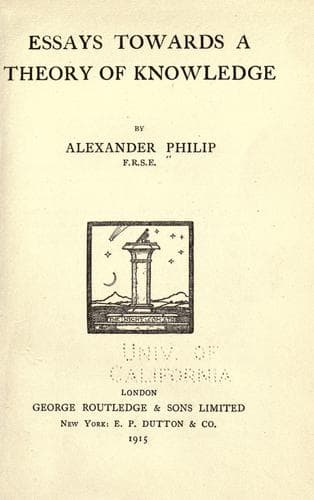
Essays Towards a Theory of KnowledgePhilip, Alexander
Philosophy
Essays Towards a Theory of Knowledge
Philip, Alexander
Cycles; Force and energy; Knowledge, Theory of
The maxims by which it was sought to constitute _a priori_ a scheme of
natural laws could not justly claim descent from the necessities of
Thought. Had the Schoolmen formed a true conception of the nature of
Knowledge they would never have imagined that any necessity of Thought
obliged them to believe that a 10 lb. weight would fall to the ground
more rapidly than a 1 lb. weight. Equally true is it that their
scientific principles had not been derived from any study of the action
of natural law. They were unacknowledged intellectual orphans.
The movement associated with the names of Galileo, Bruno, Bacon, Kepler,
and Newton owed its origin and its success to the abandonment of this
vicious principle. So far as Nature was concerned, the Mind was regarded
as a _tabula rasa_, and the physician set himself to ascertain the laws
of nature not by reflection upon his own mental processes or
requirements, but by experiment with and observation of natural
processes themselves. The result has been the establishment of modern
science--the greatest triumph which the human mind has yet achieved.
In a criticism of the writer's essay on _The Dynamic
Foundation of Knowledge_ in the _Revue neo-scolastique_ of
Louvain, the critic wrote as follows: "Remarquons qu'il n'a
pas compris la synthèse scolastique du moyen âge, elle qui
cependant a concilié d'une façon admirable l'_actuel_ et le
_potentiel_ dans l'explication de la nature des choses. Il
s'est mepris aussi sur les caractères de la méthode
scolastique de connaître la constitution intime du monde
experimental; il croît cette méthode exclusivement deductive."
We have felt that candour demanded that we should quote the
foregoing passage--coming as it does from a source
exceptionally well qualified to express an opinion. If we have
nevertheless allowed ourselves in the precedent paragraphs of
this essay to express again the view which this critic seeks
to qualify, but which we still think in the main sound, we are
at the same time very glad to be able in this way to invite
attention to the undoubted fact that the distinction between
the actual and the potential was recognised by the schoolmen
as of a very deep significance. We believe further that the
real secret of the failure of mediævalism to extend its
Knowledge of Nature was not so much a preference for
deductive over inductive methods as the failure to realise
that Nature was a dynamic operation.
It is important, then, to understand accurately what is the method of
Science.
Public-domain text, read in full here on John Shaqi.
Reviews
Reviews
No reviews yet
Be the first to share your thoughts on this work.
Join the Discussion
Join the discussion
Sign in to leave a comment or review.
Sign InorCreate an account