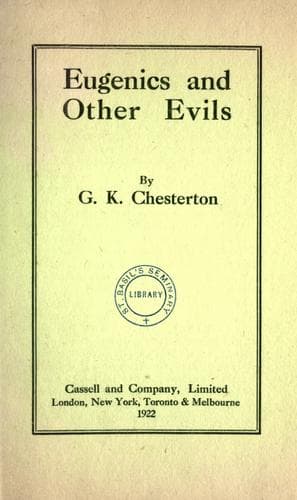
Eugenics and Other EvilsChesterton, G. K. (Gilbert Keith)
Philosophy
Eugenics and Other Evils
Chesterton, G. K. (Gilbert Keith)
Eugenics
And yet there is an exception. If there were one man at table who was
admittedly _blind_, should we not give him the benefit of the doubt?
Should we not honestly feel that he was the exception that proved the
rule? The very fact that he could not have seen would remind us that
the other men must have seen. The very fact that he had no eyes must
remind us of eyes. A man can be blind; a man can be dead; a man can be
mad. But the comparison is necessarily weak, after all. For it is the
essence of madness to be unlike anything else in the world: which is
perhaps why so many men wiser than we have traced it to another.
Lastly, the literal maniac is different from all other persons in
dispute in this vital respect: that he is the only person whom we can,
with a final lucidity, declare that we do not want. He is almost
always miserable himself, and he always makes others miserable. But
this is not so with the mere invalid. The Eugenists would probably
answer all my examples by taking the case of marrying into a family
with consumption (or some such disease which they are fairly sure is
hereditary) and asking whether such cases at least are not clear cases
for a Eugenic intervention. Permit me to point out to them that they
once more make a confusion of thought. The sickness or soundness of a
consumptive may be a clear and calculable matter. The happiness or
unhappiness of a consumptive is quite another matter, and is not
calculable at all. What is the good of telling people that if they
marry for love, they may be punished by being the parents of Keats or
the parents of Stevenson? Keats died young; but he had more pleasure
in a minute than a Eugenist gets in a month. Stevenson had
lung-trouble; and it may, for all I know, have been perceptible to the
Eugenic eye even a generation before. But who would perform that
illegal operation: the stopping of Stevenson? Intercepting a letter
bursting with good news, confiscating a hamper full of presents and
prizes, pouring torrents of intoxicating wine into the sea, all this
is a faint approximation for the Eugenic inaction of the ancestors of
Stevenson. This, however, is not the essential point; with Stevenson
it is not merely a case of the pleasure we get, but of the pleasure he
got. If he had died without writing a line, he would have had more
red-hot joy than is given to most men. Shall I say of him, to whom I
owe so much, let the day perish wherein he was born? Shall I pray that
the stars of the twilight thereof be dark and it be not numbered among
the days of the year, because it shut not up the doors of his mother's
womb? I respectfully decline; like Job, I will put my hand upon my
mouth.
CHAPTER V
THE FLYING AUTHORITY
Public-domain text, read in full here on John Shaqi.
Reviews
Reviews
No reviews yet
Be the first to share your thoughts on this work.
Join the Discussion
Join the discussion
Sign in to leave a comment or review.
Sign InorCreate an account