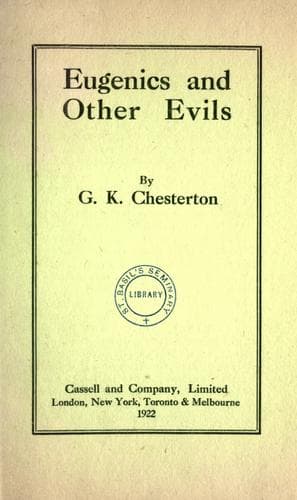
Eugenics and Other EvilsChesterton, G. K. (Gilbert Keith)
Philosophy
Eugenics and Other Evils
Chesterton, G. K. (Gilbert Keith)
Eugenics
It happened one day that an atheist and a man were standing together
on a doorstep; and the atheist said, "It is raining." To which the man
replied, "What is raining?": which question was the beginning of a
violent quarrel and a lasting friendship. I will not touch upon any
heads of the dispute, which doubtless included Jupiter Pluvius, the
Neuter Gender, Pantheism, Noah's Ark, Mackintoshes, and the Passive
Mood; but I will record the one point upon which the two persons
emerged in some agreement. It was that there is such a thing as an
atheistic literary style; that materialism may appear in the mere
diction of a man, though he be speaking of clocks or cats or anything
quite remote from theology. The mark of the atheistic style is that it
instinctively chooses the word which suggests that things are dead
things; that things have no souls. Thus they will not speak of waging
war, which means willing it; they speak of the "outbreak of war," as
if all the guns blew up without the men touching them. Thus those
Socialists that are atheist will not call their international
sympathy, sympathy; they will call it "solidarity," as if the poor men
of France and Germany were physically stuck together like dates in a
grocer's shop. The same Marxian Socialists are accused of cursing the
Capitalists inordinately; but the truth is that they let the
Capitalists off much too easily. For instead of saying that employers
pay less wages, which might pin the employers to some moral
responsibility, they insist on talking about the "rise and fall" of
wages; as if a vast silver sea of sixpences and shillings was always
going up and down automatically like the real sea at Margate. Thus
they will not speak of reform, but of development; and they spoil
their one honest and virile phrase, "the class war," by talking of it
as no one in his wits can talk of a war, predicting its finish and
final result as one calculates the coming of Christmas Day or the
taxes. Thus, lastly (as we shall see touching our special
subject-matter here) the atheist style in letters always avoids
talking of love or lust, which are things alive, and calls marriage or
concubinage "the relations of the sexes"; as if a man and a woman were
two wooden objects standing in a certain angle and attitude to each
other, like a table and a chair.
Public-domain text, read in full here on John Shaqi.
Reviews
Reviews
No reviews yet
Be the first to share your thoughts on this work.
Join the Discussion
Join the discussion
Sign in to leave a comment or review.
Sign InorCreate an account