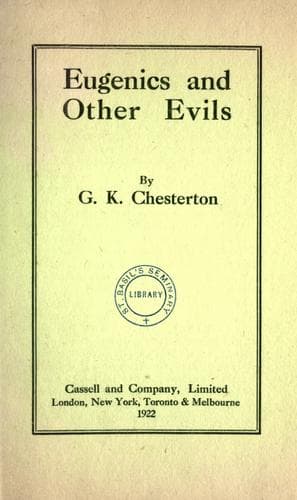
Eugenics and Other EvilsChesterton, G. K. (Gilbert Keith)
Philosophy
Eugenics and Other Evils
Chesterton, G. K. (Gilbert Keith)
Eugenics
This dilemma, which applies in so simple a case, applies equally to
any wide and sweeping system of Eugenist voting; for though it is true
that the community can judge more dispassionately than a man can judge
in his own case, this particular question of the choice of a wife is
so full of disputable shades in every conceivable case, that it is
surely obvious that almost any democracy would simply vote the thing
out of the sphere of voting, as they would any proposal of police
interference in the choice of walking weather or of children's names.
I should not like to be the politician who should propose a particular
instance of Eugenics to be voted on by the French people. Democracy
dismissed, it is here hardly needful to consider the other old models.
Modern scientists will not say that George III., in his lucid
intervals, should settle who is mad; or that the aristocracy that
introduced gout shall supervise diet.
I hold it clear, therefore, if anything is clear about the business,
that the Eugenists do not merely mean that the mass of common men
should settle each other's marriages between them; the question
remains, therefore, whom they do instinctively trust when they say
that this or that ought to be done. What is this flying and evanescent
authority that vanishes wherever we seek to fix it? Who is the man who
is the lost subject that governs the Eugenist's verb? In a large
number of cases I think we can simply say that the individual Eugenist
means himself, and nobody else. Indeed one Eugenist, Mr. A.H. Huth,
actually had a sense of humour, and admitted this. He thinks a great
deal of good could be done with a surgical knife, if we would only
turn him loose with one. And this may be true. A great deal of good
could be done with a loaded revolver, in the hands of a judicious
student of human nature. But it is imperative that the Eugenist should
perceive that on that principle we can never get beyond a perfect
balance of different sympathies and antipathies. I mean that I should
differ from Dr. Saleeby or Dr. Karl Pearson not only in a vast
majority of individual cases, but in a vast majority of cases in which
they would be bound to admit that such a difference was natural and
reasonable. The chief victim of these famous doctors would be a yet
more famous doctor: that eminent though unpopular practitioner, Dr.
Fell.
Public-domain text, read in full here on John Shaqi.
Reviews
Reviews
No reviews yet
Be the first to share your thoughts on this work.
Join the Discussion
Join the discussion
Sign in to leave a comment or review.
Sign InorCreate an account