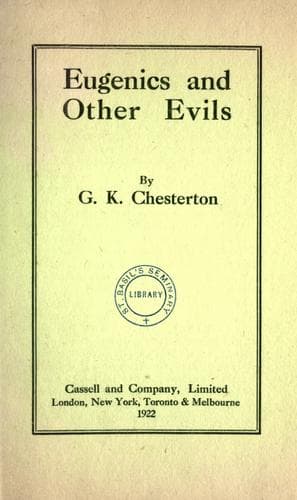
Eugenics and Other EvilsChesterton, G. K. (Gilbert Keith)
Philosophy
Eugenics and Other Evils
Chesterton, G. K. (Gilbert Keith)
Eugenics
To show that such rational and serious differences do exist, I will
take one instance from that Bill which proposed to protect families
and the public generally from the burden of feeble-minded persons.
Now, even if I could share the Eugenic contempt for human rights, even
if I could start gaily on the Eugenic campaign, I should not begin by
removing feeble-minded persons. I have known as many families in as
many classes as most men; and I cannot remember meeting any very
monstrous human suffering arising out of the presence of such
insufficient and negative types. There seem to be comparatively few of
them; and those few by no means the worst burdens upon domestic
happiness. I do not hear of them often; I do not hear of them doing
much more harm than good; and in the few cases I know well they are
not only regarded with human affection, but can be put to certain
limited forms of human use. Even if I were a Eugenist, then I should
not personally elect to waste my time locking up the feeble-minded.
The people I should lock up would be the strong-minded. I have known
hardly any cases of mere mental weakness making a family a failure; I
have known eight or nine cases of violent and exaggerated force of
character making a family a hell. If the strong-minded could be
segregated it would quite certainly be better for their friends and
families. And if there is really anything in heredity, it would be
better for posterity too. For the kind of egoist I mean is a madman
in a much more plausible sense than the mere harmless "deficient"; and
to hand on the horrors of his anarchic and insatiable temperament is a
much graver responsibility than to leave a mere inheritance of
childishness. I would not arrest such tyrants, because I think that
even moral tyranny in a few homes is better than a medical tyranny
turning the state into a madhouse. I would not segregate them, because
I respect a man's free-will and his front-door and his right to be
tried by his peers. But since free-will is believed by Eugenists no
more than by Calvinists, since front-doors are respected by Eugenists
no more than by house-breakers, and since the Habeas Corpus is about
as sacred to Eugenists as it would be to King John, why do not _they_
bring light and peace into so many human homes by removing a demoniac
from each of them? Why do not the promoters of the Feeble-Minded Bill
call at the many grand houses in town or country where such nightmares
notoriously are? Why do they not knock at the door and take the bad
squire away? Why do they not ring the bell and remove the dipsomaniac
prize-fighter? I do not know; and there is only one reason I can think
of, which must remain a matter of speculation. When I was at school,
the kind of boy who liked teasing half-wits was not the sort that
stood up to bullies.
Public-domain text, read in full here on John Shaqi.
Reviews
Reviews
No reviews yet
Be the first to share your thoughts on this work.
Join the Discussion
Join the discussion
Sign in to leave a comment or review.
Sign InorCreate an account