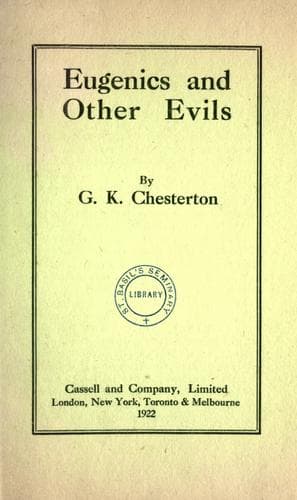
Eugenics and Other EvilsChesterton, G. K. (Gilbert Keith)
Philosophy
Eugenics and Other Evils
Chesterton, G. K. (Gilbert Keith)
Eugenics
Then there is another way of testing it: ask yourself how many people
you have met who grumbled at a thing as incurable, and how many who
attacked it as curable? How many people we have heard abuse the
British elementary schools, as they would abuse the British climate?
How few have we met who realised that British education can be
altered, but British weather cannot? How few there were that knew that
the clouds were more immortal and more solid than the schools? For a
thousand that regret compulsory education, where is the hundred, or
the ten, or the one, who would repeal compulsory education? Indeed,
the very word proves my case by its unpromising and unfamiliar sound.
At the beginning of our epoch men talked with equal ease about Reform
and Repeal. Now everybody talks about reform; but nobody talks about
repeal. Our fathers did not talk of Free Trade, but of the Repeal of
the Corn Laws. They did not talk of Home Rule, but of the Repeal of
the Union. In those days people talked of a "Repealer" as the most
practical of all politicians, the kind of politician that carries a
club. Now the Repealer is flung far into the province of an impossible
idealism: and the leader of one of our great parties, having said, in
a heat of temporary sincerity, that he would repeal an Act, actually
had to write to all the papers to assure them that he would only amend
it. I need not multiply instances, though they might be multiplied
almost to a million. The note of the age is to suggest that the past
may just as well be praised, since it cannot be mended. Men actually
in that past have toiled like ants and died like locusts to undo some
previous settlement that seemed secure; but we cannot do so much as
repeal an Act of Parliament. We entertain the weak-minded notion that
what is done can't be undone. Our view was well summarised in a
typical Victorian song with the refrain: "The mill will never grind
again the water that is past." There are many answers to this. One
(which would involve a disquisition on the phenomena of Evaporation
and Dew) we will here avoid. Another is, that to the minds of simple
country folk, the object of a mill is not to grind water, but to grind
corn, and that (strange as it may seem) there really have been
societies sufficiently vigilant and valiant to prevent their corn
perpetually flowing away from them, to the tune of a sentimental song.
Public-domain text, read in full here on John Shaqi.
Reviews
Reviews
No reviews yet
Be the first to share your thoughts on this work.
Join the Discussion
Join the discussion
Sign in to leave a comment or review.
Sign InorCreate an account