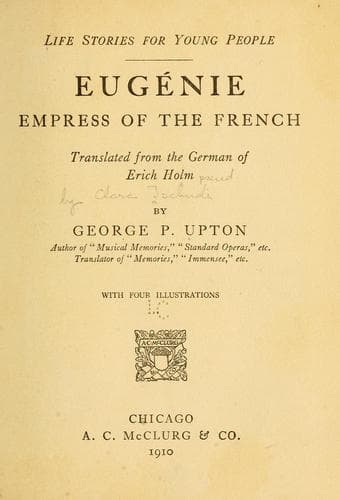
Eugénie, Empress, consort of Napoleon III, Emperor of the French, 1826-1920; Napoleon III, Emperor of the French, 1808-1873 -- Marriage
On the news of the Revolution of February and Louis Philippe’s flight,
Napoleon hastened to Paris. At the first election for a constitutional
National Assembly (April, 1848) his cause met with little support. Not
until the supplementary election did the Prince’s adherents appear as a
party, but once in the field they spared no pains to win the victory.
Bonapartist proclamations were distributed throughout Paris; and in the
course of eight days no less than six of the principal organs of the
press came out for him openly. Results showed the progress made by the
party even in this short time, for the Prince was chosen representative
of the capital of France; and similar faith was shown in him by three
other Departments. His election aroused long and heated debates in the
National Assembly, and his friends began to fear for his safety if he
remained in Paris. Returning to London, therefore, he sent a letter to
the legislature, stating that in consideration of the hostile attitude
toward him taken by the executive power, he felt it his duty to renounce
an honor it believed him to have won by fraud.
This politic withdrawal, together with the unceasing efforts of his
friends, served to influence public opinion still more in his favor. At
the new election following the June uprising the people of Paris chose
Napoleon for the second time as their representative, and after an exile
of thirty years, he hastened back to the capital to take his place in
the Assembly, from which a few months later (December 20) he was
elevated to the Presidency of the Republic.
About the time of Napoleon’s departure Eugénie and her mother also left
London, spending that summer at Spa and the following winter in
Brussels, surrounded as usual by a swarm of admirers. But all this time,
while the Prince was swiftly and surely approaching the throne of
France, Eugénie’s eyes were firmly fixed on Paris. With eager gaze she
watched the rising of Napoleon’s star, and shortly before the Empire was
proclaimed, the Spanish Countesses appeared in the capital. At last
Louis Napoleon was made Emperor. More than eight million Frenchmen had
voted for the restoration of the dynasty, and on the first of December,
1852, the Senate, the legislative body, and the Council of State paid
him homage at St. Cloud. Although formally assuming the title for the
first time on this occasion, he had in reality ruled as absolute
sovereign since the _Coup d’État_ (December 2-5, 1851). His entry into
Paris as Emperor, amid the thunder of cannon, the pealing of trumpets,
and the shouts of the multitude, was merely the crowning of a work
shrewdly planned and cleverly executed, denounced by his enemies as a
crime and glorified by his friends as a heroic achievement.
Public-domain text, read in full here on John Shaqi.
Reviews
Reviews
No reviews yet
Be the first to share your thoughts on this work.
Join the Discussion
Join the discussion
Sign in to leave a comment or review.
Sign InorCreate an account