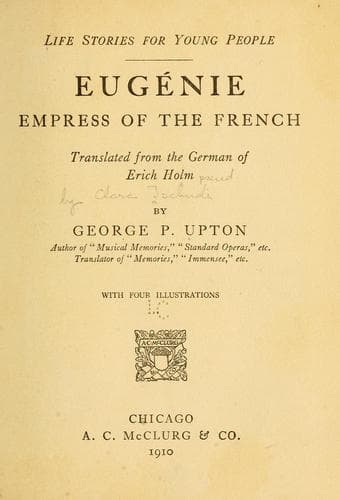
Eugénie, Empress, consort of Napoleon III, Emperor of the French, 1826-1920; Napoleon III, Emperor of the French, 1808-1873 -- Marriage
The magnificent entertainments given by the Prince-President in the
Élysée Palace, and the yet more splendid ones that followed at the
Tuileries after he became Emperor, had been presided over with tact and
grace by his cousin Mathilde, daughter of the ex-King of Westphalia.
Fifteen or sixteen years before, during a visit which Mathilde de
Montfort had paid to Arenenberg, the residence of Queen Hortense, there
had been some talk of a marriage between her and Louis Napoleon.
Hortense, who loved her niece with all a mother’s tenderness, had looked
forward with joy to a union so suitable in every respect, and it had
been agreed upon in a family council of Bonapartes. But the Prince’s
first premature attempt to secure his uncle’s throne put an end to the
plan, and Mathilde was married, in 1841, to the millionaire Prince of
San Donato, Anatole Demidoff. After a few years of childless and unhappy
marriage they separated, the Princess retiring to a villa near Paris,
whence she was summoned to the capital by her cousin when he became
President. The youthful lovers had each led a stormy life since their
last meeting, and the romantic attachment that had drawn them together
at Arenenberg had long since evaporated. In its place a firm and quiet
friendship had arisen, and for the second time Napoleon thought
seriously of marrying his cousin. It was the dearest wish of all the
Bonapartes; but again fate intervened, this time by the Church’s refusal
to annul the Princess’s marriage with Demidoff. The Prince-President
found himself forced therefore to seek elsewhere for a bride.
He sued in vain for the hand of a Russian Princess, and was refused in
turn by a sister of the King of Spain, and the Portuguese Duchess of
Braganza. However alluring may have been the chance of becoming
sovereign of France, these princesses had little desire to trust their
fate in the hands of an adventurer. Well-meaning friends next drew his
attention to the poor but beautiful Carola de Wasa, a cousin of King
Gustavus the Fourth of Sweden, afterwards Queen of Saxony. An envoy was
sent to negotiate preliminaries, and her family requested time for
consideration; but the Princess, who was most unfavorably impressed with
Napoleon’s portrait, protested with tears against the proposed marriage.
Beside himself at these repeated rebuffs, the Prince swore to win the
daughter of some royal house if forced to do it sword-in-hand, and
continued in his quest. Through his friend Lord Malmesbury, he urged
Queen Victoria to arrange an alliance between himself and her cousin,
Princess Adelaide; and though some objections were raised by the Queen
and Prince Consort, the matter was still under consideration when, on
January 19, 1853, the world was amazed by the following paragraph which
appeared in _La Patrie_, the semi-official organ of Paris, and was
copied without comment in all the other journals:
Public-domain text, read in full here on John Shaqi.
Reviews
Reviews
No reviews yet
Be the first to share your thoughts on this work.
Join the Discussion
Join the discussion
Sign in to leave a comment or review.
Sign InorCreate an account