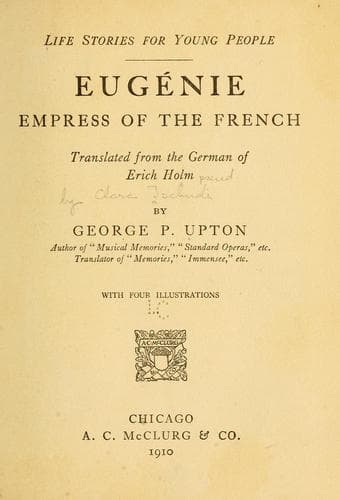
Eugénie, Empress, consort of Napoleon III, Emperor of the French, 1826-1920; Napoleon III, Emperor of the French, 1808-1873 -- Marriage
But she was no longer the innocent girl of sixteen, cherishing a
romantic passion for an Alva and deeming no sacrifice too great for her
love. Genuine as her affection doubtless was for Louis Napoleon, she
would make no sacrifices without gaining something in return. At the
height of his power and fame the man who had brought about a revolution
and made himself sole ruler of France by his shrewdness and resolution
seemed in her eyes the ideal of manly courage and heroism; yet none the
less, the hot-blooded Andalusian showed herself in this case as cold as
ice. Her experience of life had taught her that denial was the surest
means of stimulating a passion. The Emperor was not easily caught,
however. He despatched a confidential friend to the Countess de Montijo,
not to ask for her daughter’s hand, but to make it clear to the shrewd
woman of the world that Eugénie could not count on being Empress.
Reasons of state prevented his placing the crown on the head of his
beloved, although such an event might not be an impossibility should he
be free to follow his desires in the future. But the Countess, like her
daughter, being well aware of the surest means of attaining her end,
made short work of the Emperor’s envoy. Repeated attempts at persuasion
proved equally fruitless, and Eugénie finally sent Napoleon, with her
respectful greetings, the message: “Cæsar’s wife should be above
suspicion.”
[Illustration: _EMPRESS EUGÉNIE_]
Goaded on by this reserve, the Emperor could no longer restrain himself,
and the Countess’s persistent refusals furnished him a welcome excuse
for broaching the plan of a marriage with her. It met with violent
opposition from all his relatives and friends, who did all in their
power to dissuade him from it, imploring him to choose, in default of a
royal princess, at least some French lady of rank or lineage known to
the people. To divert him from his purpose a marriage was proposed with
the Polish Princess Czartoryska. But completely absorbed by his passion
for Eugénie their opposition only served to fan the flame, and at last,
to end the painful subject, he asked one of his court ladies, the
Princess Lieven, whether he should choose the Princess Czartoryska or
Mlle. de Montijo. To which she cleverly replied, “If you leave it to me,
Sire, I prefer the Cachucha to the Mazurka”—an answer which Napoleon
accepted as the voice of fate. At the earliest opportunity he sent a
formal request to the Countess Montijo for the hand of her daughter, and
was of course welcomed by both with open arms.
Public-domain text, read in full here on John Shaqi.
Reviews
Reviews
No reviews yet
Be the first to share your thoughts on this work.
Join the Discussion
Join the discussion
Sign in to leave a comment or review.
Sign InorCreate an account