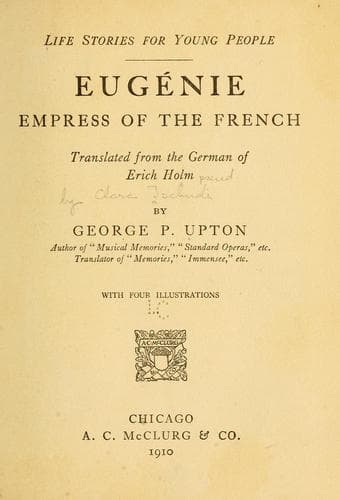
Eugénie, Empress, consort of Napoleon III, Emperor of the French, 1826-1920; Napoleon III, Emperor of the French, 1808-1873 -- Marriage
The news of the betrothal excited endless wonder but little
satisfaction. There was almost a panic in the Bourse, that political
barometer, and the Emperor’s intimate friends and family went about with
gloomy faces. The proposed marriage was openly opposed in the
ministerial council and regarded with great disfavor by the general
public; in short, only three persons were really pleased—Eugénie, her
mother, and Napoleon. As for the first, her wildest hopes were at last
to be realized. From doubtful obscurity she was to rise to loftiest
heights. Providence had chosen her for this position and she bowed to
its decree. The week that intervened between the betrothal and the
wedding ceremonies slipped by in an intoxication of happiness. She was
greeted on all sides with respect and adulation, and overwhelmed with
protestations of devotion from the courtiers. The proudest nobles of
France paid homage to her. Her enemies were silent, while Napoleon’s
friends who had been most bitterly opposed to the match now fawned upon
her, greedy for favors from their future Empress.
The civil marriage was celebrated quietly on the twenty-ninth of
January; but the magnificence of the religious ceremony exceeded
anything that had been seen in France since the days of the great
Napoleon. From early morning a double row of troops lined the way from
the Tuileries to Notre Dame. All Paris was on the alert to catch at
least a glimpse of the spectacle. The railroads brought more than two
hundred thousand people into the capital from the provinces, and a
motley throng filled the streets, richly decorated with flags and
banners bearing the names of Napoleon and Eugénie, and gay with the
light _toilettes_ of the ladies, and the gold embroidered uniforms of
the soldiers glittering in the sun. Although midwinter, the sky was
clear and the air mild as spring. About half-past eleven, Eugénie
started from the Élysée for the Tuileries. Her mother was seated beside
her, and opposite them the master of ceremonies, Count Tascher de la
Pagerie. The natural beauty of the bride was enhanced still more by the
magnificent gown she wore, a gift from the city of Liége. It was of
white velvet with an overdress of costly lace woven in a pattern of
violets. A jewelled girdle encircled the waist, and on her head was the
diamond coronet worn by Marie Louise on her wedding day, attached to
which were the lace veil and a wreath of orange blossoms. As the
prospective Empress entered the gates of the Tuileries, Prince Napoleon
and the Princess Mathilde appeared at the foot of the staircase to
receive her, while trumpets sounded and the troops presented arms.
Public-domain text, read in full here on John Shaqi.
Reviews
Reviews
No reviews yet
Be the first to share your thoughts on this work.
Join the Discussion
Join the discussion
Sign in to leave a comment or review.
Sign InorCreate an account