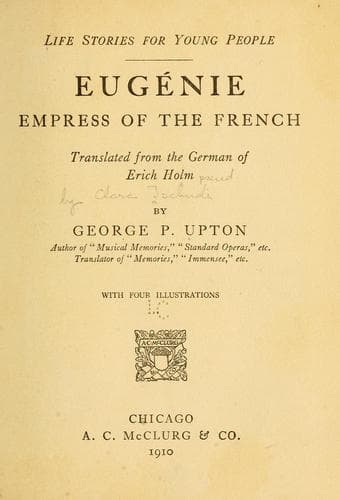
Eugénie, Empress, consort of Napoleon III, Emperor of the French, 1826-1920; Napoleon III, Emperor of the French, 1808-1873 -- Marriage
“The interest displayed by the people in their new sovereign was
prompted by more than idle curiosity. The universal admiration she
excited was genuine. Those noble features, enhanced by their
expression of sweetness and modesty, irresistibly attracted the
working classes, who felt that the Empress regarded them with kindness
and good-will.”
This assertion was not groundless, for although public opinion, as we
have seen, had been against the Emperor’s choice, and although among the
cheering throngs that greeted the sovereigns there was much secret
dissatisfaction, the spell of Eugénie’s beauty and charm of manner was
so potent that even her enemies were silenced by it. The lovely face
with its regular delicate features suggests in contour the portraits of
Mary Stuart. Her complexion was dazzling and her brown hair full of
golden gleams. Under the heavy lashes and delicately pencilled eyebrows,
her blue eyes, so dark as almost to seem black, were full of fire and
softness, reflecting the tender heart and dauntless soul within. The
Andalusians are famous for the beauty of their hands and feet, and
Eugénie’s did not belie her origin. The lines of her figure and the
curves of her neck were as perfect as those of an antique statue; in
short, hers was a flawless exterior in which no discord marred the
complete harmony of the picture.
Thus elevated to a throne, Eugénie burned with desire to make herself
beloved by the people, to excite the admiration of those about her, and
silence all hints as to her birth and checkered past. Controlling her
naturally impulsive and passionate nature when necessary, concealing her
pride and ambition under a modest, almost humble air, she left nothing
undone to add to her popularity and strengthen her position. Two
qualities invaluable to a sovereign she naturally possessed—magnanimity
and an open hand. Before the wedding the official journals had brought
many proofs of her kindness of heart to the knowledge of the public—such
as, that the Empress, having beheld an accident to a poor workman who
fell from a scaffold, sprang from her coach to hasten to the aid of the
unfortunate man and had him carried to a hospital; and on another
occasion, seeing a poor abandoned child wandering in the street, the
Emperor’s bride had taken it into her own carriage and promised to
provide for its future. Still another and striking instance of this was
her refusal to accept a diamond necklace valued at six hundred thousand
francs which the Municipal Council of Paris had intended to present to
her. She wrote a most gracious letter conveying her thanks to the
Council for their loyal intention, but declaring she could not consent
that Paris should make so great a sacrifice in her behalf, or that the
Emperor’s wedding should lay any more burdens on the country; adding
that her sole desire was to share with the Emperor the affections of the
people, and expressing a wish that the six hundred thousand francs might
Public-domain text, read in full here on John Shaqi.
Reviews
Reviews
No reviews yet
Be the first to share your thoughts on this work.
Join the Discussion
Join the discussion
Sign in to leave a comment or review.
Sign InorCreate an account