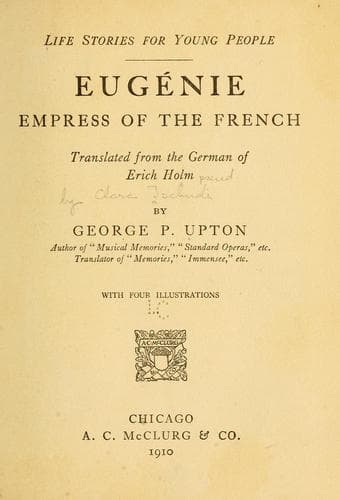
Eugénie, Empress, consort of Napoleon III, Emperor of the French, 1826-1920; Napoleon III, Emperor of the French, 1808-1873 -- Marriage
be devoted to charity. This could not fail to create a good impression;
and after the wedding many other examples of the same kind occurred. She
gave freely to all who approached her with petitions, conscious only
that help was needed; and many kind and consoling words accompanied the
large sums she privately bestowed. Indeed, in 1863 she went so far as to
insure her life in favor of the poor that they might not suffer by her
death; and she laid the foundations of many noble works of charity that
will cause her name to be honored long after she herself is forgotten.
Besides her generosity Eugénie possessed a thousand ways of attracting
and winning people to her. The Emperor’s love had raised her to the
throne; it depended solely on herself and her tact to maintain her
position on it. With her inborn dignity, her beauty, and her queenly
grace, she was as well equipped by nature for the part as any royal
princess; indeed many a sovereign born might well have envied her, as,
sparkling with jewels, she stood beneath the canopy of the throne to
receive the foreign diplomats and nobles of the Empire. When she
appeared on horseback beside the Emperor at grand reviews, or rode
through the city in the imperial coach, bowing in response to the shouts
of the dazzled crowds, nothing could have been more beautiful. It was
plain to all that the Empress well knew how to play her part.
Seldom have two persons better suited to one another than Napoleon and
Eugénie, or more completely in accord, been united. In all the pomp and
power of her sovereignty she never forgot that it was to him she owed it
all; and in proportion as the sense of her own importance rose, her love
and admiration for him increased also. In the eyes of the world he had
taken a step downward in his choice of a bride; it was now her task to
prove that “the adventuress” could be as useful to the dynasty as a
consort born in the purple.
“I would rather be spoken ill of than not be spoken of at all!” Louis
Napoleon had exclaimed when his first attempts to bring about a
political revolution had only excited pity and derision. Even at that
time he had studied the French people well, and knew their weak spot was
vanity. To flatter the national vanity therefore became one of his
principal agencies for maintaining his power; and while in private life
he loved an almost plebeian simplicity, in public no effect was too
striking or too spectacular to keep up his imperial state.
Public-domain text, read in full here on John Shaqi.
Reviews
Reviews
No reviews yet
Be the first to share your thoughts on this work.
Join the Discussion
Join the discussion
Sign in to leave a comment or review.
Sign InorCreate an account