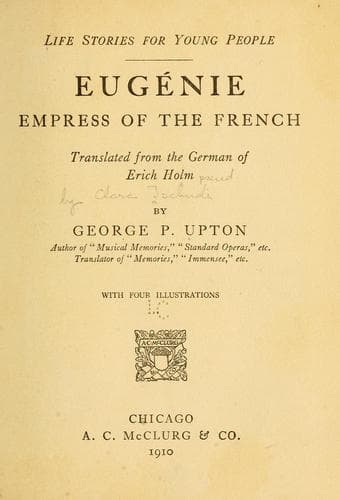
Eugénie, Empress, consort of Napoleon III, Emperor of the French, 1826-1920; Napoleon III, Emperor of the French, 1808-1873 -- Marriage
That evening the city of Paris gave a magnificent banquet in honor of
the imperial family, at which the whole court and many foreign guests
were present. It was held in the great hall of the Hôtel de Ville, lit
up by eighteen thousand wax candles. The silver service used was made
expressly for the occasion at a cost of two hundred and fifty thousand
francs and the flowers alone came to twenty thousand francs. Two
orchestras alternated in furnishing music; and at the close all present
rose and sang “_Vive l’Empereur!_” The popularity of the Empress was
proven by a surprise that had been prepared for her in the form of a
diorama representing the various places with which she had some special
association:—Granada her birthplace; Madrid, with the Prado; the forest
of Compiègne; Fontainebleau, where the Emperor had confessed his love
for her; the chamber which she had occupied in the Élysée before her
marriage; the wedding of the imperial pair at Notre Dame; the Prince
Imperial’s apartment at the Tuileries; the palace of St. Cloud; and the
cascade in the Bois de Boulogne. At the conclusion of the banquet
Napoleon and Eugénie appeared on one of the balconies of the Hôtel de
Ville and were greeted with the wildest enthusiasm by the crowds that
had gathered to admire the fireworks and the illuminations. All were
charmed with the Emperor’s graciousness and the beauty of the Empress,
but most of all with the little Prince Imperial whom the people
affectionately nicknamed “Lulu.”[1]
Chapter VI
The Empress in Politics
Napoleon’s position at this time seemed impregnable. France had played
an honorable part in the Crimean War and covered herself with glory at
the fall of Sebastopol. Yet the nephew of the great Napoleon had
remained far from the field of battle himself, and felt the need of
winning some personal laurels to add to his prestige. The shrewd policy
of Count Cavour, the Italian statesman, had greatly increased the power
of the kingdom of Sardinia; and thither the Emperor now turned his
glances. At a secret meeting with Cavour he guaranteed the support of
France to Sardinia in case of war with Austria; but before this pledge
could be redeemed an event occurred which might have made the agreement
of little avail. It deserves mention here as furnishing a proof of
Eugénie’s courage.
Public-domain text, read in full here on John Shaqi.
Reviews
Reviews
No reviews yet
Be the first to share your thoughts on this work.
Join the Discussion
Join the discussion
Sign in to leave a comment or review.
Sign InorCreate an account