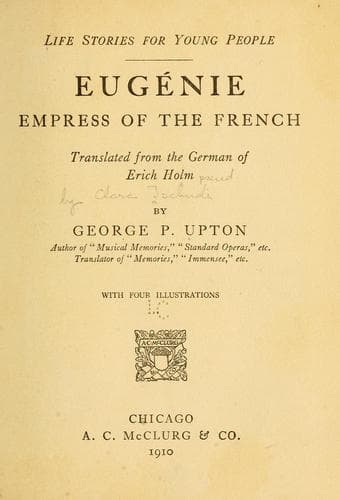
Eugénie, Empress, consort of Napoleon III, Emperor of the French, 1826-1920; Napoleon III, Emperor of the French, 1808-1873 -- Marriage
If any decisive influence on French politics was attributed to Eugénie
on this or subsequent occasions, it was a mistaken idea. As a matter of
fact her regency was little more than an empty farce in which Napoleon
allowed his wife to play the chief part. It deluded the people and
flattered the Empress to see her name at the head of all state
documents; but absent or present, although he permitted Eugénie to share
in the ministerial councils, he was careful not to trust the reins of
government for any length of time to other hands than his own. On the
other hand, it cannot be denied that the Empress, when she chose to
exert herself, well knew how to achieve her ends. Once an idea became
fixed in her mind she would assail the Emperor with arguments and
entreaties until he finally yielded, if only for the sake of peace; nor
did she scruple to intrigue against the ministers when they refused to
carry out her wishes in the bestowal of honors and positions on
favorites of her own, often quite unworthy of such favors.
Her real political influence was greatly overestimated. Her talents did
not lie in that direction, nor had she any conception of the intricate
machinery of government. Absorbed in a thousand trifles, court
festivals, fashions, and intrigues, she had neither time nor inclination
to pursue such aims with any system or resolution. Yet there was one
case in which she did make trouble by her interference. This was shortly
before the Franco-Prussian War, when she brought all her influence to
bear in behalf of the Church.
The Papal party had spared no pains to secure Eugénie’s friendship and
strengthen her in the conviction that she had been chosen by Providence
as one of the chief supports of God’s vicegerent on earth. Full of
gratitude to the Deity for this special mark of favor, and firmly
believing in her destiny, she yielded blindly to all the wishes of the
clergy, thus openly proclaiming herself the head of the clerical party.
She devoted her energies to the support of the Papal power and to a
revival of the spirit of Catholicism throughout the country. No mercy was
shown to those who dissented from the old faith. Even her attendants,
with few exceptions, were chosen according to their religious views.
Naturally this overzealousness could not fail to excite much opposition,
and Eugénie soon had not only the envy and prejudice of society to
contend against, but the enmity of the free-thinkers, including many of
Napoleon’s best friends.
Public-domain text, read in full here on John Shaqi.
Reviews
Reviews
No reviews yet
Be the first to share your thoughts on this work.
Join the Discussion
Join the discussion
Sign in to leave a comment or review.
Sign InorCreate an account