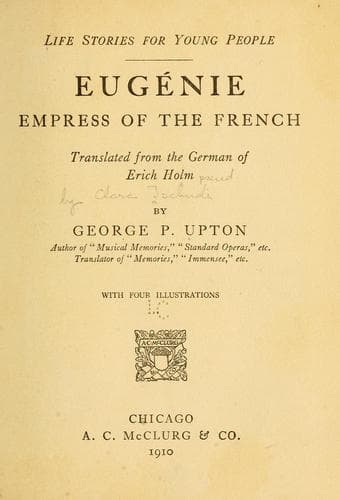
Eugénie, Empress, consort of Napoleon III, Emperor of the French, 1826-1920; Napoleon III, Emperor of the French, 1808-1873 -- Marriage
Next to Pauline Metternich the most important member of the Empress’s
small private circle was Prosper Merimée, the clever author—“the
Empress’s court jester,” as he laughingly called himself. He had first
met the Countess Montijo while Eugénie was still a child, and the
acquaintance had ripened with years into a close friendship which was
shared by the imperial pair. Although not strictly speaking a member of
the court, both Napoleon and Eugénie treated him as a member of their
family, and the bigoted Empress not only honored him as a gifted author,
but felt an almost sisterly affection for the avowed free-thinker.
Chapter VIII
Paris under the Second Empire
The Danish writer, Hermann Bang, says:
“It was a strangely mixed society that formed the court of the Second
Empire, and during this splendid period Paris became more than ever a
brilliant social arena. New names and new celebrities sprang up like
mushrooms and withered away as quickly. Since life was short, it must
needs be rapid. Looking back upon it now, one is reminded of a
juggler’s performance at the circus. The glittering balls fly about in
bewildering numbers and seem to fill the whole air. Different
performers come and go, but the dazzling display continues. This
society was neither composed of the representative families of France
nor yet of the mass of the population, who supported the Government,
and to whom the Second Empire seemed a complete restoration of the
glories of the First. Truly the richest legacy of greatness is the
magic that lies in a name.”
Napoleon was well aware of the value of the name he bore. He had not
forgotten that to it alone he owed his possession of the throne; and he
determined that the name at which Europe had trembled and which all
France adored should serve as the foundation of his power. As far as
possible he tried to revive all the Napoleonic traditions and preserve
the fond illusion of the Parisians. Everything about the court was
conducted on a scale of the greatest magnificence. Uniforms of
officials, ministers, and deputies were a mass of gold embroidery. The
gorgeousness of the palace guards suggested the operatic stage; customs
of the time of Louis the Fourteenth were even revived. Visits from
foreign sovereigns were attended with an almost fabulous display, and
with Napoleon’s rising importance these visits became more and more
frequent. Indeed there were times during the Second Empire when whole
solar systems of potentates revolved about one another.
Public-domain text, read in full here on John Shaqi.
Reviews
Reviews
No reviews yet
Be the first to share your thoughts on this work.
Join the Discussion
Join the discussion
Sign in to leave a comment or review.
Sign InorCreate an account