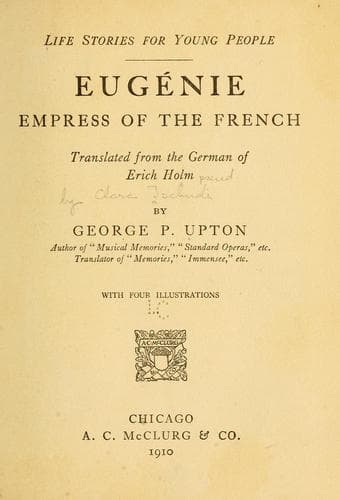
Eugénie, Empress, consort of Napoleon III, Emperor of the French, 1826-1920; Napoleon III, Emperor of the French, 1808-1873 -- Marriage
On Thursday evenings during the winter, dinners were given at the
Tuileries for diplomats and state officials, followed by receptions and
dancing. Four court balls were given in the course of the season, to
which as many as five thousand invitations were issued, and which were
marked by the utmost splendor. Both sides of the grand staircase were
lined with palace guards. Guests waited in the galleries until the
arrival of the sovereigns, when the doors of the great salon were thrown
open and the Emperor and Empress took their places on the dais, the
princes and princesses grouped about them. The Empress danced only the
opening quadrille on these occasions, and at eleven retired with the
Emperor to a smaller salon where there was also dancing.
Eugénie possessed the truly royal gift of never forgetting a face or a
name, and always had a kindly word or glance for every one as she passed
through the crowded room; but when it was over and she reached her own
apartments, she would be completely exhausted with the weight of the
crown jewels, which she wore in the greatest profusion on these
occasions. Sometimes she would not even wait for her women, but would
snatch off the crown and heavy ornaments and toss them into the lap of
the lady-in-waiting, who bore them carefully away, for each was worth a
fortune. Besides these grand balls to which any one with the slightest
claim to rank or position could easily obtain admission, the most
splendid and original masquerades were given in Carnival time, to which
invitations were more limited. During Lent there were no entertainments
with the exception of four state concerts given under the direction of
Auber, then court _kapellmeister_, and Count Bacciocchi, director of the
theatre, in which all the most famous artists took part.
Far more interesting than these semi-official affairs were the weekly
Monday receptions held by the Empress in her own apartments. Only a
select few were invited to these, and the Empress’s “Mondays” soon
became famous all over Europe. Napoleon and Eugénie received their
guests with the greatest cordiality, and conversed familiarly with all.
Here Princess Metternich shone her brightest; here too were seen the
beautiful Princess Murat, Duchess of Monchy; the gallant Count Walewski,
who so closely resembled his father, the great Napoleon; the Emperor’s
half-brother, the Duke de Morny; and his youthful friend and ally Duke
Fialni de Persigny. Here Merimée’s inexhaustible fund of wit and humor
found full play. Here the Emperor’s favorite, General Fleury, and the
elegant Marquis de Caux (afterward the husband of Adelina Patti) led the
cotillon and invented figures that made the rounds of Europe.
Public-domain text, read in full here on John Shaqi.
Reviews
Reviews
No reviews yet
Be the first to share your thoughts on this work.
Join the Discussion
Join the discussion
Sign in to leave a comment or review.
Sign InorCreate an account