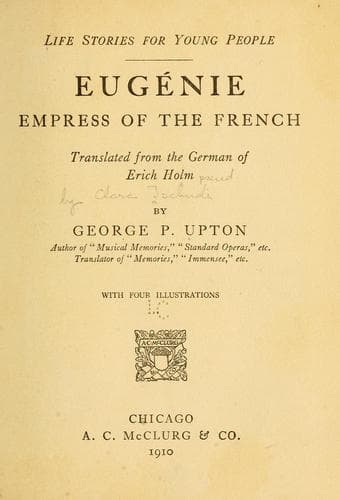
Eugénie, Empress, consort of Napoleon III, Emperor of the French, 1826-1920; Napoleon III, Emperor of the French, 1808-1873 -- Marriage
The court of the Second Empire was full of corruption and was abandoned
to a life of pleasure and luxury. But it is ever the way of aristocratic
society to seek amusement; and if at the courts of Berlin and London a
more serious tone prevailed, those of Vienna, St. Petersburg, and Madrid
were scarcely less frivolous than that of France under the Second
Empire.
The Empress’s daily life was very different from this; intermixed with
the feverish pursuit of pleasure were many days of weariness and ennui.
At eight o’clock she rose and devoted an hour regularly, sometimes two
or three, to her favorite occupation, the study of her _toilettes_. At
half-past eleven she breakfasted alone with the Emperor and the Prince
Imperial, after which Napoleon would smoke a cigarette in his wife’s
apartment, chatting and playing with his little son. Kindness of heart
was one of the Emperor’s most marked characteristics. Indeed he was
often over-indulgent with the child—a weakness Eugénie continually
struggled against, with the natural result that the little Prince
preferred his father to his mother. At one, every day he went for his
drive in the Bois de Boulogne, and the Empress retired to her study,
back of the audience chamber, where no one was allowed to enter. Here
her tastes and habits were best displayed, for in this room she had
surrounded herself with all her most precious possessions, portraits of
her family and intimate friends, busts, vases, statuettes, and all sorts
of personal souvenirs, and a small set of bookshelves containing the
works of French, Spanish, English, and Italian writers. Every day
Eugénie wrote to her mother, a sacred duty with which neither _fête_ nor
illness, travel nor court entertainment, was ever allowed to interfere.
Among others with whom she also kept up a lively correspondence were
Queen Victoria and the Queen of Holland. After the Empress’s personal
letters were finished she summoned her secretary, Damas Hinard, with
whom she went through the vast number of begging letters and appeals of
all kinds she received daily, to each of which she gave her personal
attention.
Adjoining Eugénie’s bedchamber was an anteroom without windows in which
a lamp was always burning, and from which a narrow stairway led to the
Emperor’s apartments. Concealed in the wainscoting of this room by
sliding panels were a number of caskets, all numbered and marked in
cipher. To look over and arrange their contents was one of Eugénie’s
favorite amusements. Here she kept not only her own private papers, but
many interesting contributions to the history of Napoleon the First and
his times, in the form of letters from statesmen, soldiers, and scholars.
All the Emperor’s discarded documents and correspondence were carefully
preserved by Eugénie, and stored away where only she could get at them.
Napoleon was much amused at this mania of hers for collecting, and she
herself used to laugh over it.
Public-domain text, read in full here on John Shaqi.
Reviews
Reviews
No reviews yet
Be the first to share your thoughts on this work.
Join the Discussion
Join the discussion
Sign in to leave a comment or review.
Sign InorCreate an account