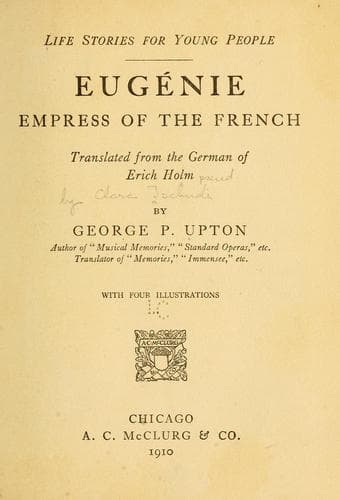
Eugénie, Empress, consort of Napoleon III, Emperor of the French, 1826-1920; Napoleon III, Emperor of the French, 1808-1873 -- Marriage
Scarcely less famous in their way were the hunting parties held by the
court at Compiègne every autumn. To these only a few were invited at a
time, and the weekly list of guests was prepared with as much care as if
it had been some important affair of state. Fifteen new gowns of the
costliest kind were regarded as indispensable by the feminine world for
a visit to Compiègne. Many feigned illness to escape the expense of so
many new _toilettes_, while others were almost ruined by accepting the
invitations. Art, literature, and science were well represented at these
gatherings; and once arrived at Compiègne, all received the most cordial
welcome, no matter what their political opinions.
Next to court entertainments the most popular rendezvous for the world
of fashion in the days of the Empire was the opera; and although it then
had its home in the narrow _Rue Lepelletier_, instead of its present
magnificent palace, this did not deter royalty and all the highest
society from attending regularly. Full dress was required, and the
costly gowns and the jewels of the ladies, with the brilliant uniforms
of the men, lent an air of festivity to each performance that is usually
seen only on some gala occasion. But if grand opera were the temple of
art in which Eugénie showed herself most often, it was by no means her
favorite place of amusement. She not only lacked all knowledge of the
higher music, but it was distasteful to her; and even well written drama
at the Théâtre Français had no interest for her. On the other hand, she
adored anything amusing and had the greatest fondness for Offenbach’s
lively airs. Her musical taste may be judged by the fact that during the
Czar Alexander of Russia’s stay in Paris in 1867, she could think of no
greater mark of attention than to send him tickets for a performance of
the “Grande Duchesse de Gerolstein.”
Her fancied resemblance to Marie Antoinette has already been mentioned;
indeed, there were many points of similarity between the Spanish
Countess and Maria Theresa’s unfortunate daughter. Both possessed
remarkable beauty, charm, energy, and strength of character. Both were
boundlessly extravagant and open-handed, as both in their younger days
allowed the pursuit of pleasure to banish all serious occupations.
Eugénie avoided the imprudences of which Marie Antoinette was guilty,
and instead of risking her popularity, did all in her power to preserve
and strengthen it; yet she too was powerless to escape calumny. There
were but too many evil tongues ready to suggest that a woman who owed
her sovereignty to beauty alone was scarce likely to remain a pattern of
virtue, and we have seen how even in her own family she had enemies who
tried to undermine her reputation.
Public-domain text, read in full here on John Shaqi.
Reviews
Reviews
No reviews yet
Be the first to share your thoughts on this work.
Join the Discussion
Join the discussion
Sign in to leave a comment or review.
Sign InorCreate an account