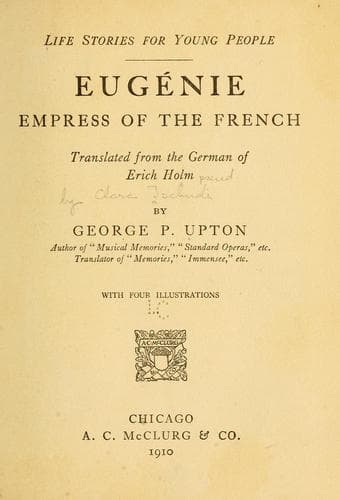
Eugénie, Empress, consort of Napoleon III, Emperor of the French, 1826-1920; Napoleon III, Emperor of the French, 1808-1873 -- Marriage
The dinner hour at the Tuileries was half-past seven. At this meal the
Prince Imperial, after his eighth year, was present as well as all the
ladies and gentlemen of the court. Shortly before the hour, the Emperor
went to his wife’s apartments and escorted her to the Hall of Apollo,
where the court awaited Their Majesties. As soon as dinner was served
the palace prefect was notified, who in turn informed the Emperor;
Napoleon gave his arm to Eugénie and the rest followed in order of rank.
The ceremony was simple but strictly in accordance with etiquette. At
table a young blackamoor, whom she had brought with her from Algiers,
always stood behind Eugénie’s chair, and waited on her with as lofty an
air as if he were fulfilling some sacred office. He was said to be of
noble birth, and proudly refused to serve any one but the Empress.
After dinner, which was served with such smoothness and precision that
it seldom lasted more than three-quarters of an hour, the court returned
to the Hall of Apollo, where the evening was spent, usually in a most
tedious manner. The presence of the sovereigns prevented any spontaneous
general conversation. The Emperor himself rarely spoke at all, while
Eugénie, finding this atmosphere of repression unbearable, talked
incessantly with the nervous vivacity peculiar to her. To vary the
monotony of these evenings, reading aloud was sometimes suggested but it
was difficult to find anything suitable for such an assemblage. A French
or English romance would entertain the Empress but bored the Emperor
horribly; while if a scientific work that interested Napoleon were
chosen, Eugénie would yawn, therefore this too had to be abandoned.
The Emperor was fond of solitaire, which he often played; but it did not
amuse Eugénie except when she did not feel like talking, which was
seldom the case. There was never music or card-playing at the palace.
Once in a great while the Empress would have a sudden fancy to do
something, as when, for example, late one evening a courtier was hastily
despatched to procure all the necessary materials for making artificial
flowers, that she might learn the art at once. On another occasion it
was the desire to model in clay that must be gratified on the spot.
Punctually at ten, a table was brought in with tea and cakes, which the
ladies served themselves, and conversation now became general. Between
eleven and twelve the Empress withdrew to her own apartments and
generally retired at once though she sometimes kept her reader, Mlle.
Bouvet, to read aloud to her after she was in bed. As a general rule,
however, she preferred to read to herself which she did often and very
rapidly.
Chapter IX
Eugénie as a Leader of Fashion
Public-domain text, read in full here on John Shaqi.
Reviews
Reviews
No reviews yet
Be the first to share your thoughts on this work.
Join the Discussion
Join the discussion
Sign in to leave a comment or review.
Sign InorCreate an account