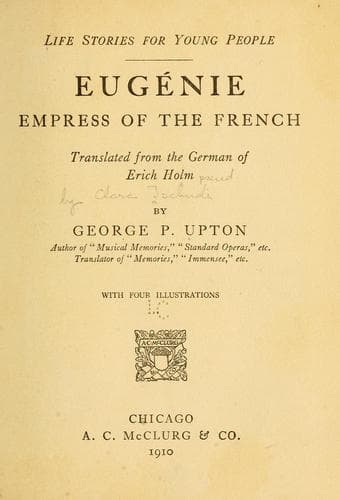
Eugénie, Empress, consort of Napoleon III, Emperor of the French, 1826-1920; Napoleon III, Emperor of the French, 1808-1873 -- Marriage
The stairways and corridors in the Tuileries were so dark that they had
to be lighted summer and winter; and this, with the bad ventilation,
made the palace so unbearable in warm weather that the court spent the
summer months away from Paris, at Fontainebleau, St. Cloud, or Biarritz.
Of these resorts Napoleon’s favorite was St. Cloud, where he usually
went to recuperate from the severe attacks of illness to which he was
subject. Here he was quite happy, playing with his dog Nero, a faithful
companion for many years, or tending his roses in the palace garden.
Eugénie, on her part, preferred Biarritz, in the Pyrenees, and it was
owing largely to her that this resort became by far the most popular in
France, casting Dieppe, Trouville, and Boulogne completely in the shade.
Nowhere in the world could there have been found such a medley of wealth
and poverty, aristocrats and adventurers, high-born dames and
demi-mondaines of all classes, as at Biarritz in the days of the Second
Empire. It had attractions of all sorts, hotels and restaurants, shops
and bazars of every description, as well as a casino containing a
theatre, concert hall, ball and gaming rooms, from the broad terrace of
which there was a most charming view.
Opposite the town, on a rocky plateau across a narrow arm of the sea,
stood the Château Eugénie. It looked more like a barracks than a palace,
and owing to the salt spray flung all around it in time of storm, no
sort of vegetation would thrive there; but when the Empress stepped out
on her terrace in the morning, the sea lay spread out at her feet. The
ever changing lights and shades of sky and water lent variety to the
solitary landscape; while looking the other way she could watch the gay
equipages rolling by toward the baths. This to her was the ideal
combination of nature and civilization. In this beautiful spot Eugénie
spent some of her happiest hours, forgetful of the tedium of court life,
her husband’s infidelities, and the persecutions of Prince Napoleon and
his followers. Here her natural high spirits found vent, and she romped
like a child with her little son, or revelled in the sea-bathing,
feeling for the first time since her early youth the charms of a life
free from excitement or ambitious aims.
Public-domain text, read in full here on John Shaqi.
Reviews
Reviews
No reviews yet
Be the first to share your thoughts on this work.
Join the Discussion
Join the discussion
Sign in to leave a comment or review.
Sign InorCreate an account