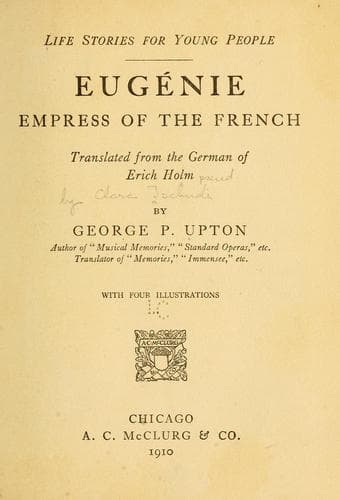
Eugénie, Empress, consort of Napoleon III, Emperor of the French, 1826-1920; Napoleon III, Emperor of the French, 1808-1873 -- Marriage
She was tireless in her quest for novelty. With each change of season,
quantities of models and materials were brought to her to choose from,
and numberless conferences were held with Madame Virot, the court
milliner, as well as Worth, the famous ladies’ tailor, whose reputation
she founded. He would often send her costumes costing one or two hundred
thousand francs, and once he made her pay as much as fifty thousand
francs for a simple cloak. Even these works of art met with no mercy in
their original form, but were always remodelled and altered according to
her orders, until her own carefully cultivated taste produced the
desired effect of perfect harmony. All the artistic talent she possessed
was devoted to the study of dress, and under her sway fashion rose into
the realm of art. Inseparable from the image of the beautiful Spaniard
is the energy with which for eighteen long years she wielded its
sceptre. Her greatest interest in life, it constituted at once her
strength and her weakness—weakness because from it sprang the charge of
folly and extravagance justly made by France against its former
sovereign; strength, because of the art with which it enabled her to
hold her place on the pedestal to which she had been elevated, and gave
her the power to dazzle and fascinate not only the masses but also her
equals and contemporaries.
Chapter X
Decline of the Empire
As yet there had been no sign of change in Eugénie’s fortunes. The sun
of empire was still apparently at its zenith. France deemed herself
invincible. The throne seemed secured to the present dynasty for all
time. The Emperor’s policy had received some severe blows, however, and
disquieting rumors floated over from the ill-fated Empire he had founded
in Mexico.
Maximilian and Carlotta had often visited the Tuileries in their younger
days, and it was only by Napoleon’s urgent persuasion and promise of
support until his throne should be firmly established that the Austrian
Archduke consented to accept the fatal crown. Mindful of this promise,
in his hour of need Maximilian sent his wife to Europe to seek
Napoleon’s aid. She arrived in Paris at night, and without pausing a
moment to rest after the long wearisome sea voyage she hastened to St.
Cloud, her disordered dress and distracted appearance betraying her
terrible agitation. She had brought over the letters Napoleon had
written to her husband, promising his support. Handing these to the
Emperor, she flung herself at his feet imploring him to keep his word.
But all in vain. Even had he wished, he could have done nothing; and
sobbing aloud, half senseless with despair, Carlotta is said to have
left St. Cloud with a curse on her lips, crying: “Louis Philippe’s
granddaughter should never have trusted her fate to a Bonaparte!”
Public-domain text, read in full here on John Shaqi.
Reviews
Reviews
No reviews yet
Be the first to share your thoughts on this work.
Join the Discussion
Join the discussion
Sign in to leave a comment or review.
Sign InorCreate an account