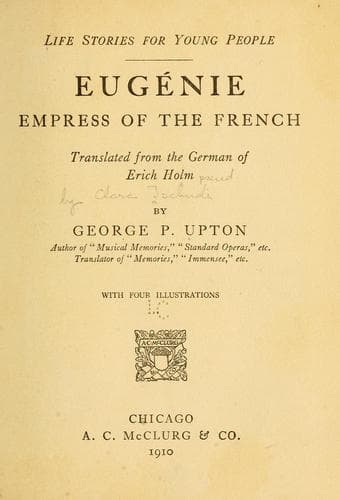
Eugénie, Empress, consort of Napoleon III, Emperor of the French, 1826-1920; Napoleon III, Emperor of the French, 1808-1873 -- Marriage
Yet much as Eugénie had endeared herself to the masses by her
fearlessness and kind-heartedness during the cholera epidemic, it was
not long before the feeling against her on account of her bigotry,
extravagance, and frivolity again came to the surface, not alone in
court circles but throughout the whole Empire. To lay to the Empress’s
account all the follies and indiscretions, all the worldliness and
self-seeking, of Parisian life at that time, would be most unfair; yet
it cannot be denied that her influence had much to do with the luxury
and the eccentricities of fashion that prevailed. Doomed by her rank to
a life of idleness and inactivity, the lack of proper food for heart and
mind forced her energies to find outlet in trifles. The gratification of
her vanity became the chief object of life. With the sceptre of France,
her slender hand also grasped that of the world of fashion—a domain in
which she was no beneficent sovereign, but a tyrant whose yoke was borne
without a murmur. Even when she was a young girl her costumes excited
envy and admiration for their originality, and at every watering-place
she visited, bungling imitations of the beautiful Spaniard’s _toilettes_
were to be seen in hotels and gaming halls. In Paris her influence soon
began to be felt, and almost before her name had become familiar to the
people her waistcoats were being copied and sold by all the fashionable
tailors, and the high-heeled riding boots she had worn at Compiègne were
adopted by every French court lady. Every morning, as we have seen,
before going to mass, Eugénie devoted one or two hours at least to the
study of dress.
Her bedchamber, with its adjoining oratory, was at some distance from
her other apartments and lacked all stamp of individuality. The bed,
heavily draped with rich hangings, was raised on a dais, and resembled a
throne. In this room she kept the Golden Rose that was presented to her
by the Pope, and beside the bed stood one of the palm branches sent her
each year by the Holy Father with his blessing. Yet here she spent far
less time during the day than in the dressing-room next it, where there
were several large movable mirrors enabling her to see herself from all
points. On the floor above, connected by elevator and speaking tube with
her private apartments, were the rooms occupied by her waiting-women.
Here was a vast store of silks, velvets, and satins, with gowns and
every conceivable article of wearing apparel. Ranged along the wall were
rows of dresses and wraps of all sorts and colors, with receptacles for
hats, shoes, fans, parasols, etc. In one of the rooms were several
life-sized forms which the Empress had had made, exactly reproducing her
own figure in size and height, and dressed like living women to the
smallest detail; for in spite of the pains taken by the modistes and
tailors to win her approval, it was seldom that a costume entirely
suited her.
Public-domain text, read in full here on John Shaqi.
Reviews
Reviews
No reviews yet
Be the first to share your thoughts on this work.
Join the Discussion
Join the discussion
Sign in to leave a comment or review.
Sign InorCreate an account