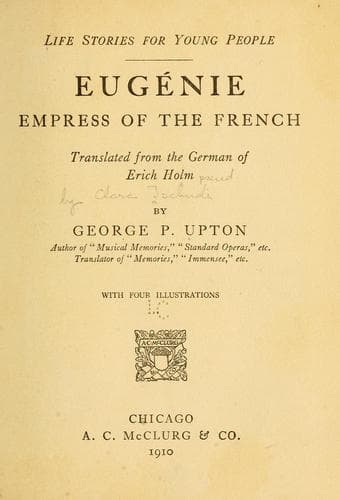
Eugénie, Empress, consort of Napoleon III, Emperor of the French, 1826-1920; Napoleon III, Emperor of the French, 1808-1873 -- Marriage
The death of the Prince Imperial created the profoundest sensation. As
soon as the news reached England, Colonel Sidney, an old friend of the
family, was sent to break it to the Empress, but before he could get to
Chiselhurst she had already heard of it. That morning all newspapers and
telegrams had been carefully withheld from her, but her letters were
overlooked. One of these was doubly addressed, to her and to Secretary
Pietri, and contained an allusion to “the dreadful news” without
mentioning what it was. She sent at once for the Duke of Bassano to ask
for an explanation; and when he arrived speechless with emotion, she
suspected that it concerned the Prince. Chilled with fear at what she
read in his countenance, she stood as if turned to stone. That son, for
whom she longed day and night, her only joy in life! The thought was so
terrible, Eugénie could not pursue it to the end.
“Something has happened to my son,” she groaned; “I must start at once
for the Cape.”
Unable to reply, the Duke went out into the hall, where he met Colonel
Sidney, who brought confirmation of the sad tidings. The Empress sent
again for the Duke and insisted upon hearing all, repeating that she
should go to Africa at once.
“Alas! madame,” said the Duke, “it is too late.”
“Oh, my son—my poor son!” shrieked the mother, and fell senseless to the
floor.
After the first paroxysm of grief was over, she neither wept nor spoke,
but listened with feverish despair while the Duke related all the
circumstances of her son’s death, not withholding a single painful
detail. Madame Lebreton then led her gently into her bedchamber where
the Abbé Goddard tried to comfort her. But the religion that had been
such a source of support to her through all her troubles now proved of
little consolation. Her whole life had been bound up in her child, and
now that this last earthly support had crumbled, all hope and joy lay
buried in the dust. For several days and nights she neither ate nor
slept, but remained sunk in a sort of torpor from which she roused only
to ask in tones of agonized pleading if it might not be that her son was
only ill or wounded, and she could go out to nurse him back to health.
Fortunately for her life or reason, she at last found relief in tears,
and now she wept unceasingly.
The whole world shared the stricken mother’s sorrow, and thousands of
messages of sympathy were received at Chiselhurst. Telegrams of
condolence came from all the courts of Europe, as well as from President
Grévy of the French Republic, Marshal MacMahon, and many others. Requiem
masses were held in every Roman Catholic church in London. Especial
sympathy was felt for her in Spain, but the consolation of weeping out
her grief on a mother’s bosom was denied her, as the Countess Montijo
was then so old and feeble it was thought best not to inform her of her
grandson’s death.
Public-domain text, read in full here on John Shaqi.
Reviews
Reviews
No reviews yet
Be the first to share your thoughts on this work.
Elsewhere in the archive
Join the Discussion
Join the discussion
Sign in to leave a comment or review.
Sign InorCreate an account